LLM SEO: How to Optimize Your Brand for Large Language Models
When someone asks an AI assistant “which project management tool is best for agencies?”, the answer depends on what the model has learned and what it can find right now. LLM SEO is the practice of shaping both, so your brand shows up accurately and often.
This guide explains how large language models (LLMs) form opinions about brands, how they retrieve fresh information, and ten practical tactics to improve your visibility. You’ll also learn which tools can track your progress.
LLM SEO is the practice of improving how large language models understand, mention and cite your brand. It works on two levels: shaping the training data that forms a model’s long-term knowledge, and optimizing content for real-time retrieval when the model searches the web. Consistent brand facts, authoritative mentions and citable content drive both.
What Is LLM SEO?
LLM SEO (large language model search engine optimization) is the process of optimizing your brand, content and online presence so that AI models such as GPT, Gemini, Claude and Llama describe your business accurately and recommend it for relevant questions.
It overlaps with generative engine optimization and AI search optimization. The main difference is emphasis: LLM SEO pays special attention to how the model itself learns about your brand, not just how AI search features retrieve pages.
How LLMs Learn About Your Brand
LLMs get information in two ways:
| Source | How it works | How you influence it |
|---|---|---|
| Training data | Models learn patterns from huge snapshots of public text | Consistent, widespread, accurate mentions over time |
| Live retrieval (RAG) | Models search the web and read pages during a conversation | Crawlable, well-ranked, clearly structured content |
Training data: the long game
During training, models absorb how often brands appear alongside certain topics and what is said about them. If thousands of trusted sources describe your company as “a leading HR platform for startups,” the model is more likely to repeat that association.
Live retrieval: the short game
When an AI tool searches the web, it behaves more like a search engine. It retrieves pages, chooses passages and cites them. Here, classic SEO and answer engine optimization matter most.
Training data shapes what an AI believes. Retrieval shapes what it can prove.
Why LLM SEO Matters
- AI assistants are becoming a starting point for product research.
- Models often name only three to five brands per answer.
- Incorrect or outdated information about your brand can spread.
- Being mentioned builds trust before a buyer ever visits your site.
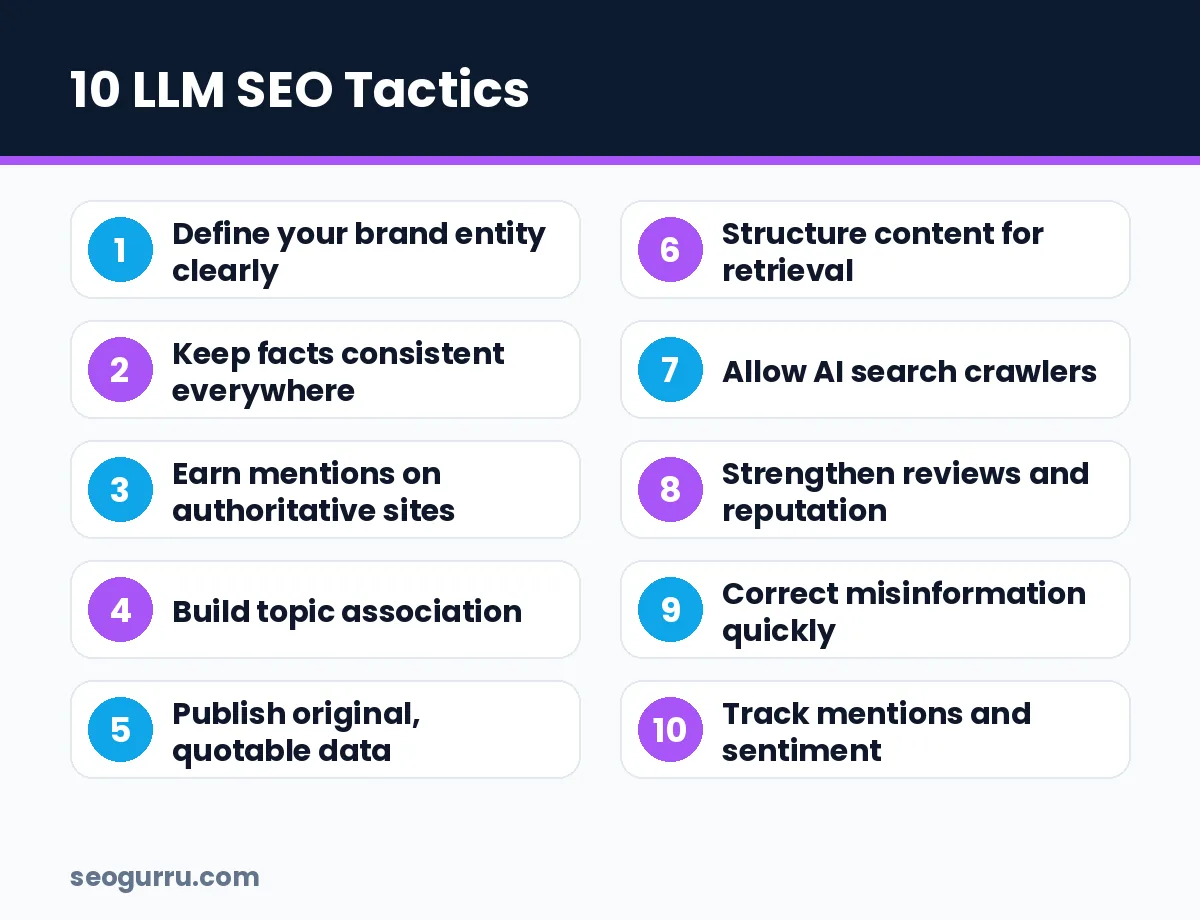
10 LLM SEO Tactics
1. Define your brand entity clearly
Write a clear, factual description of who you are, what you offer and who you serve. Use it on your homepage, About page, Organization schema and social profiles. Our entity SEO guide explains why entities matter.
2. Keep facts consistent everywhere
Name, founding year, headquarters, products, pricing tiers and leadership should match across your website, LinkedIn, Crunchbase, Google Business Profile, directories and, where eligible, Wikipedia and Wikidata. Inconsistencies confuse models.
3. Earn mentions on authoritative sites
High-quality publications, industry associations, academic sources and respected blogs carry weight in training data and retrieval. Digital PR and expert commentary are core LLM SEO activities.
4. Build topic association
Repeatedly connect your brand with your core topics. Publish deep content clusters, speak at events, appear on podcasts and contribute to industry reports on the same themes. The goal is for your brand and topic to co-occur often across the web.
5. Publish original, quotable data
Statistics and research are among the most cited content types. Release annual reports, benchmarks or survey results with clear, quotable findings.
6. Structure content for retrieval
Use descriptive headings, short answer-first paragraphs, tables and lists. Each section should make sense on its own so retrieval systems can pull it out cleanly.
7. Allow AI search crawlers
Make sure crawlers such as OAI-SearchBot, PerplexityBot, Bingbot and Googlebot can access your content. Decide separately whether to allow training crawlers like GPTBot, Google-Extended and ClaudeBot, based on your business goals.
8. Strengthen reviews and reputation
Reviews on G2, Capterra, Trustpilot, Google and industry-specific platforms provide third-party evidence that models often rely on when making recommendations.
9. Correct misinformation quickly
Test what AI tools say about your brand. If they repeat outdated pricing or wrong facts, update the source pages they cite, publish clear corrections and request updates on third-party sites.
10. Track mentions and sentiment
Monitor how often you’re mentioned, in what context and with what sentiment. Compare against competitors over time.
- LLM SEO works on both training data and live retrieval.
- Consistent brand facts and authoritative mentions shape AI knowledge.
- Citable, structured content wins in real-time AI search.
LLM SEO Tools
Several tools now help track brand visibility across AI models:
- Ahrefs Brand Radar for AI mention tracking and share of voice
- Semrush AI Toolkit for AI visibility and sentiment
- Profound, Peec AI and Otterly.ai for prompt-level tracking across platforms
- Google Analytics 4 for AI referral traffic
- Manual prompt testing with a simple spreadsheet for small budgets
Choose one tool and a fixed set of prompts so your data stays comparable month to month.
LLM SEO vs Traditional SEO: What Changes?
| Area | Traditional SEO | LLM SEO |
|---|---|---|
| Main goal | Rank pages | Be mentioned and recommended |
| Key asset | Your website | Your brand’s presence everywhere |
| Links | Ranking signal | Also a source of brand association |
| Unlinked mentions | Minor value | Significant value |
| Success metric | Rankings and clicks | Mentions, citations, sentiment |
The biggest mindset shift is that your website is only part of the picture. What others say about you matters just as much.
LLM SEO Mistakes to Avoid
- Trying to “inject” content into AI models with spammy, repetitive pages
- Publishing large volumes of low-quality AI-generated content
- Ignoring off-site reputation and focusing only on your own website
- Blocking every AI bot without understanding the visibility trade-off
- Expecting instant results from changes to training data, which updates slowly
How to Run an LLM Brand Audit
Before optimizing, find out what AI models currently say about you. A simple audit takes an afternoon:
- Ask direct questions. “What is [brand]?”, “What does [brand] offer?” and “Who are [brand]’s competitors?”
- Ask category questions. “Best [category] for [audience]” and “Top
companies in [location].”
- Ask comparison questions. “[Brand] vs [competitor]” and “[Brand] alternatives.”
- Record the answers across ChatGPT, Gemini, Perplexity, Copilot and Claude.
- Score each answer for accuracy, sentiment and whether you’re mentioned at all.
- List the sources that AI tools cite, then prioritize improving or earning mentions on those sources.
Repeat the audit every quarter to measure progress.
Frequently Asked Questions
What is LLM SEO?
LLM SEO is the practice of optimizing your brand and content so that large language models like GPT, Gemini and Claude understand your business accurately and mention or cite it in relevant answers. It combines brand consistency, authoritative mentions and retrieval-friendly content.
Is LLM SEO the same as GEO?
They overlap heavily. Generative engine optimization focuses on visibility in AI-generated search answers, while LLM SEO also emphasizes how models learn about brands through training data. In practice, most tactics serve both goals.
How do I check what AI says about my brand?
Ask several AI assistants direct questions about your brand, your category and your competitors, and record the answers. Repeat monthly with the same prompts, and use AI visibility tools if you need to track many prompts at scale.
How long does LLM SEO take?
Improvements to retrieval-based visibility can appear within weeks if your pages are already indexed and ranking. Changing how models describe your brand in their core knowledge can take many months, because it depends on new training cycles and broader mentions.
Conclusion
LLM SEO is about making sure AI models know who you are, what you’re best at and why they should trust you. Define your brand clearly, keep facts consistent, earn mentions on authoritative sites and structure your content so AI can retrieve and quote it.
Start with a brand audit: ask five AI tools about your company and note what they get right and wrong. Want expert support? Our AI SEO services help brands grow LLM visibility, or start with a free SEO analysis.