SEO vs SEM: Key Differences and Which One Your Business Needs
You want more customers from Google, and everyone tells you something different. One person says “do SEO,” another says “run ads.” The truth is that SEO vs SEM is not a fight with one winner. It’s a choice about speed, budget and how long you plan to compete.
In this guide, you’ll learn the real difference between SEO and SEM, the pros and cons of each, what they cost, and a simple framework for choosing the right mix for your business.
SEO (search engine optimization) earns free, organic rankings over time. SEM (search engine marketing) usually means paid search ads that show immediately but stop when you stop paying. Use SEM for fast results and testing; use SEO for long-term, compounding traffic. Most growing businesses benefit from both.
What Is SEO?
SEO, or search engine optimization, is the process of improving your website so it ranks higher in unpaid (organic) search results. It includes keyword research, content creation, technical improvements and earning links from other websites.
You don’t pay Google for clicks. Instead, you invest time and resources to earn visibility.
What Is SEM?
SEM, or search engine marketing, is the practice of promoting a website in search engines, most commonly through paid ads such as Google Ads and Microsoft Ads. You bid on keywords, and your ads appear at the top or bottom of results marked “Sponsored.”
Some marketers use SEM as an umbrella term covering both SEO and paid search. In everyday use, though, “SEM” usually means paid search, and that’s how we’ll use it here.
SEO vs SEM: The Key Differences
| Factor | SEO | SEM (Paid Search) |
|---|---|---|
| Cost model | Time, content and expertise | Pay per click (PPC) |
| Speed | 3–6+ months for results | Traffic within hours |
| Longevity | Compounds over time | Stops when budget stops |
| Placement | Organic results, AI answers | Sponsored ad slots |
| Click trust | Often higher | Some users skip ads |
| Testing speed | Slow | Fast A/B testing |
| Targeting | Broad, intent-based | Precise: location, device, time, audience |
Paid search rents attention. SEO builds an asset you own.
Pros and Cons of SEO
Pros:
- Traffic keeps flowing without paying per click
- Builds credibility and brand trust
- Feeds AI answers and featured snippets
- Lower cost per lead over time
Cons:
- Slower to show results
- Rankings can shift with algorithm updates
- Requires consistent effort and expertise
Pros and Cons of SEM
Pros:
- Immediate visibility for any keyword you can afford
- Precise targeting and budget control
- Fast data for testing offers and messaging
- Great for seasonal promotions and launches
Cons:
- Costs rise as competition rises
- Traffic stops as soon as you pause ads
- Requires ongoing management to avoid wasted spend
- Ad fatigue and ad blockers reduce reach
How Much Do SEO and SEM Cost?
SEO costs depend on scope. Small businesses often invest $500–$2,500 per month with an agency or consultant, while competitive and enterprise programs cost much more. You’ll find a detailed breakdown in our upcoming guide on how much SEO costs.
SEM costs depend on your keywords’ cost per click (CPC). Some local service keywords cost $2–$10 per click, while legal, insurance and software terms can exceed $50 per click. Add management fees if you hire help.
A simple example
A local plumber pays $12 per click for “emergency plumber near me.” With a 10% conversion rate, each lead costs $120. Meanwhile, an optimized service page ranking organically for the same term may generate leads for a fraction of that cost after a few months, but it takes time to get there.
When to Choose SEO, SEM or Both
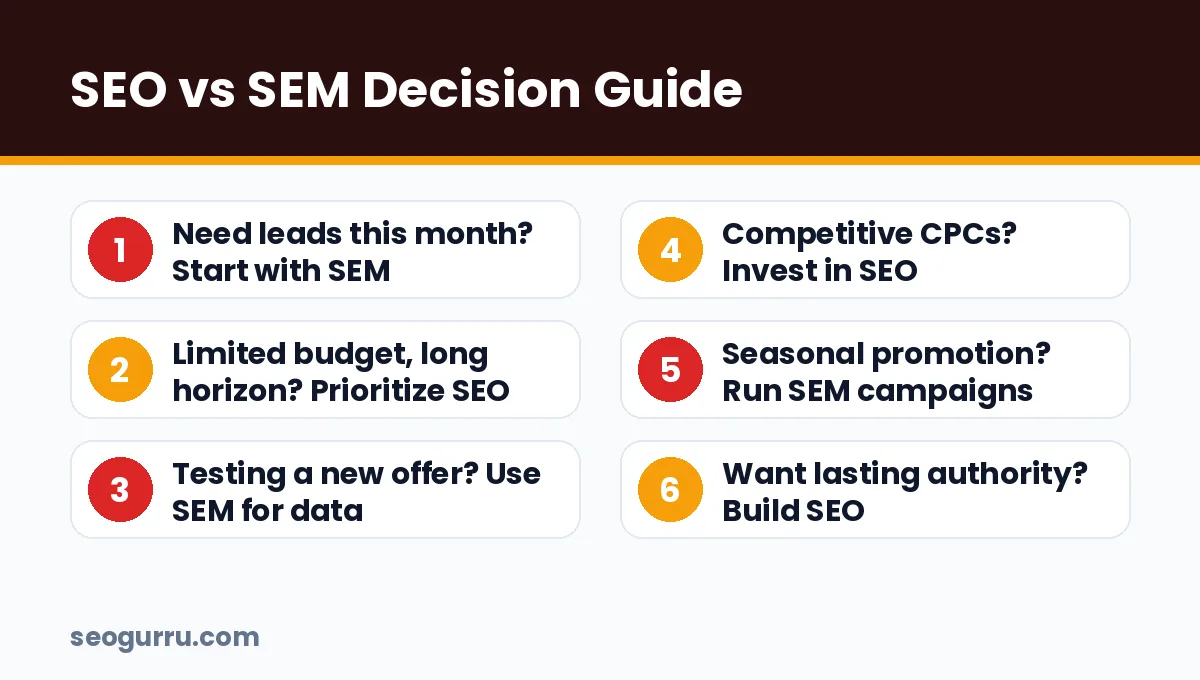
Choose SEM first if…
- You’re launching a new business or product and need sales now
- You’re running a time-sensitive promotion
- You want to test which keywords and offers convert before investing in content
Choose SEO first if…
- You have a longer timeline and limited ad budget
- Your industry has expensive CPCs
- You want to build brand authority and AI visibility
Choose both if…
- You can afford ads while SEO matures
- You want to dominate the results page with both paid and organic listings
- You want to use paid data to inform your SEO keyword strategy
How SEO and SEM Work Together
The smartest strategy uses each channel to strengthen the other:
- Use SEM data for SEO. Find the keywords that convert best in ads, then build organic pages for them.
- Use SEO to lower ad costs. Strong landing pages improve Quality Score, which can reduce your cost per click.
- Cover gaps. Run ads on terms where you don’t rank yet, then reduce spend as organic rankings improve.
- Retarget organic visitors. Show ads to people who read your blog but didn’t convert.
- SEM is fast but temporary; SEO is slow but compounding.
- Choose by goal, timeline and budget, not by trend.
- Combining both gives you speed today and lower costs tomorrow.
SEO vs SEM by Business Type
The right balance changes with your business model. Here are typical starting points:
| Business type | Suggested starting mix | Why |
|---|---|---|
| New local service business | 60% SEM, 40% SEO | Needs calls now; local SEO grows in parallel |
| Established local business | 30% SEM, 70% SEO | Map Pack and reviews drive steady leads |
| Ecommerce store | 50% SEM, 50% SEO | Shopping ads plus category and product SEO |
| B2B or SaaS company | 30% SEM, 70% SEO | Long research cycles reward content |
| Content publisher | 0–10% SEM, 90%+ SEO | Revenue depends on organic traffic |
Treat these as starting points, not rules. Review your cost per lead in each channel every quarter and shift budget toward what works.
How to Track and Compare Results
To compare SEO and SEM fairly, measure both channels with the same yardstick:
- Set up conversion tracking in Google Analytics 4 for calls, forms and purchases.
- Link Google Ads and Google Search Console to GA4 so paid and organic data sit side by side.
- Calculate cost per lead for each channel. For SEO, divide your monthly SEO investment by organic leads.
- Look at lifetime value. Organic customers often find you through research and may stay longer.
- Review blended performance. Sometimes ads and organic listings together lift total clicks more than either alone.
Clear tracking turns the SEO vs SEM debate into a data decision rather than a matter of opinion.
Common Mistakes When Choosing Between SEO and SEM
- Expecting SEO results in 30 days and quitting too early
- Running ads to a weak landing page and blaming the channel
- Bidding on broad keywords without negative keywords
- Ignoring tracking, so you can’t compare cost per lead across channels
Frequently Asked Questions
What is the main difference between SEO and SEM?
The main difference is how you pay for visibility. SEO earns free organic rankings through content, technical improvements and links, which takes time. SEM usually means paid search ads, which deliver instant visibility but cost money for every click.
Is SEO or SEM better for small businesses?
It depends on your timeline and budget. SEM is better when you need leads quickly. SEO is better for long-term, lower-cost growth. Many small businesses start with a modest ad budget while building SEO, then shift budget toward SEO as rankings grow.
Is SEM the same as PPC?
Not exactly. PPC (pay-per-click) is a pricing model used in paid search and other ad platforms. SEM refers to marketing in search engines. In practice, most SEM campaigns use PPC, so the terms often overlap.
Can SEO and SEM be used together?
Yes, and they often work best together. Paid search provides fast keyword and conversion data that can guide SEO, while strong SEO landing pages improve ad Quality Scores and lower costs.
Conclusion
The SEO vs SEM debate has a simple answer: use the right tool for the right job. SEM delivers speed, control and fast testing. SEO delivers trust, lasting traffic and a lower cost per lead over time. For most businesses, the winning plan combines both and shifts budget as organic results grow.
Not sure where to start? Our SEO services team can build a plan around your goals, or request a free SEO analysis to see how much organic opportunity you’re missing today.