B2B SEO: A Proven Strategy to Generate Qualified Leads
Your buyers are already searching. Before a B2B decision-maker ever talks to sales, they research problems, compare vendors and read reviews, often without telling anyone. B2B SEO puts your company in front of them during that silent research phase.
But B2B search is a different game from consumer SEO. Keywords have lower volume, buying groups are bigger, and one lead can be worth thousands of dollars. In this guide, you’ll learn a step-by-step B2B SEO strategy, the best practices that drive qualified leads, and how to measure results your CFO will care about.
B2B SEO is the process of ranking for the searches your business buyers make while researching problems and vendors. Focus on bottom-funnel keywords first, build solution and comparison pages, support them with expert content, and measure success by pipeline, not traffic.
What Is B2B SEO?
B2B SEO (business-to-business search engine optimization) is the practice of optimizing a company’s website to rank for searches made by professional buyers, so it can generate leads, demos and sales from organic search.
Unlike B2C SEO, which often chases high-volume keywords, B2B SEO targets smaller, high-value queries. Ten searches a month for “SOC 2 compliance software for startups” can be worth more than 10,000 searches for a generic consumer term.
How B2B SEO Differs From B2C SEO
| Factor | B2B SEO | B2C SEO |
|---|---|---|
| Search volume | Low, specialized | High, broad |
| Buyer | Committee of 6–10 people | Usually one person |
| Sales cycle | Weeks to months | Minutes to days |
| Conversion goal | Demo, quote, consultation | Purchase |
| Content depth | Technical, ROI-driven | Emotional, convenience-driven |
These differences shape every decision, from keyword selection to how you report results.
Why B2B SEO Matters for Lead Generation
- Buyers self-educate. Most of the B2B buying journey happens online before contact with sales.
- Organic leads compound. A page that ranks keeps generating leads without paying per click.
- Trust is earned in search. Ranking for expert topics positions you as the authority.
- Paid costs keep rising. Competitive B2B keywords can cost $20–$100+ per click in Google Ads.
In B2B, one well-ranked comparison page can outperform a hundred top-of-funnel blog posts.
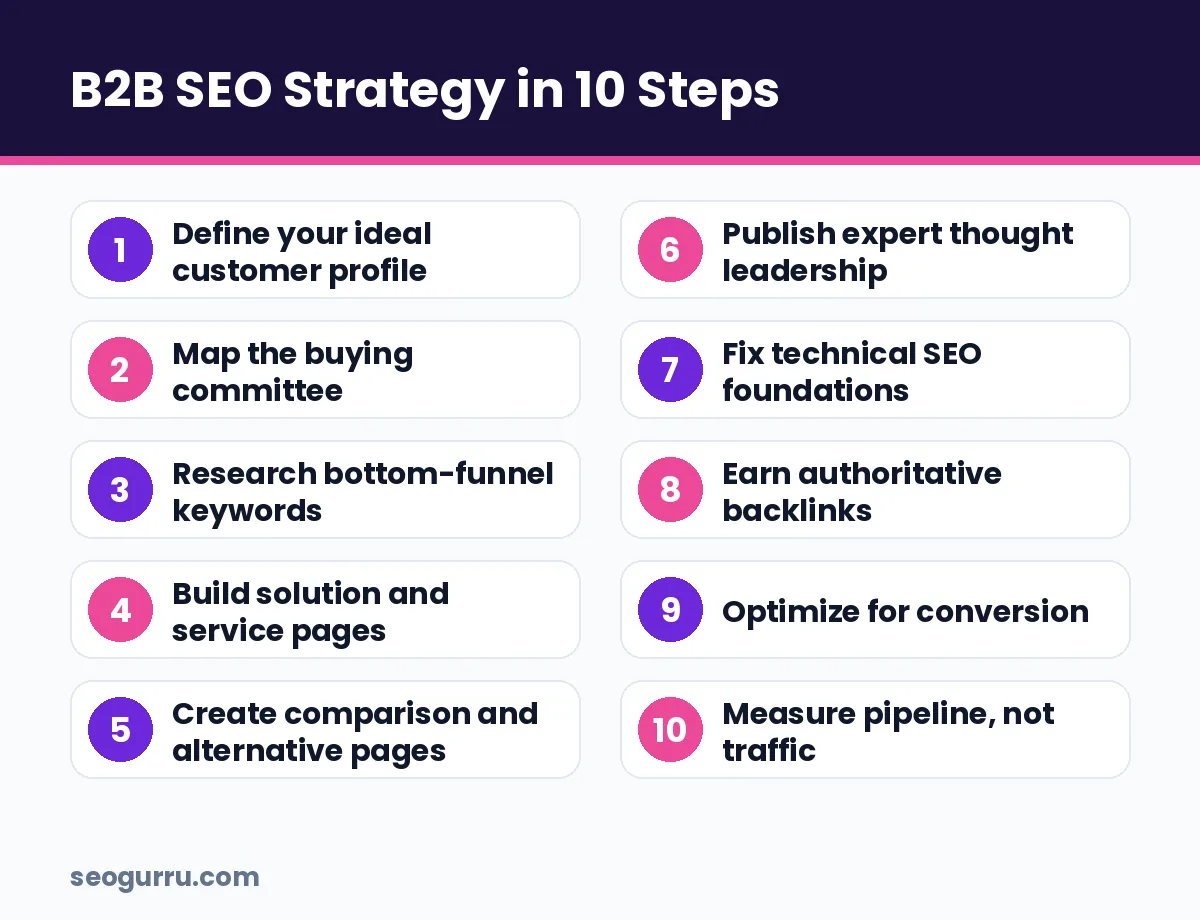
How to Build a B2B SEO Strategy in 10 Steps
1. Define your ideal customer profile (ICP)
List the industries, company sizes, job titles and pain points of your best customers. Talk to your sales team and review closed-won deals. Your keyword strategy should serve these people, not everyone.
2. Map the buying committee
B2B purchases involve several roles. A CFO searches for “ROI of marketing automation,” while an IT manager searches “marketing automation API integration.” Create content for each stakeholder so your brand shows up in every part of the buying group’s research.
3. Research bottom-funnel keywords first
Start where intent is highest. Look for keywords that signal buying readiness:
- “[category] software” or “
agency”
- “best [solution] for [industry]”
- “[competitor] alternatives”
- “[product A] vs [product B]”
- “[solution] pricing”
Use Ahrefs or Semrush to find these, then check Google Search Console for queries you already appear for. Our keyword research guide covers the process step by step.
4. Build solution and service pages
Every core offer deserves a dedicated, optimized page. Each one should explain the problem, your solution, proof (case studies, logos, numbers), pricing guidance and a clear call-to-action. Avoid lumping five services onto one page.
5. Create comparison and alternative pages
Buyers actively search “X vs Y” and “X alternatives.” If you don’t create these pages, review sites and competitors will. Be fair and factual. Honest comparisons build trust and convert at high rates.
6. Publish expert thought leadership
Top-of-funnel content still matters, but it should show real expertise. Interview your engineers, share original data and write about lessons from real projects. This type of content earns links and AI citations, and builds the authority that helps your money pages rank.
7. Fix technical SEO foundations
Many B2B sites run on heavy CMS setups with slow pages, gated PDFs and JavaScript-rendered content. Make sure your key pages are:
- Crawlable and indexed
- Fast, especially on mobile (see our Core Web Vitals guide)
- Free of duplicate content from tag pages and resource libraries
- Linked logically through a clear internal linking strategy
8. Earn authoritative backlinks
B2B link building works best through relationships and assets: industry reports, partner pages, podcast appearances, guest articles in trade publications and integrations directories. A few links from respected industry sites beat hundreds of low-quality links.
9. Optimize pages for conversion
Traffic is only useful if it converts. Add multiple conversion paths for different readiness levels:
- High intent: demo request, free consultation, pricing quote
- Medium intent: case study downloads, ROI calculators, webinars
- Low intent: newsletter, checklist or template downloads
10. Measure pipeline, not just traffic
Connect your analytics to your CRM. Track organic leads, sales-qualified leads, opportunities and revenue by landing page. This proves value to leadership and shows which content to double down on.
- Start with bottom-funnel keywords and money pages.
- Create content for every member of the buying committee.
- Report on pipeline and revenue, not vanity traffic.
B2B SEO Content Types That Convert
- Solution pages that target “
for [industry]”
- Case studies with measurable results and named clients
- Comparison pages for “vs” and “alternatives” searches
- Pricing pages that explain cost factors transparently
- Glossaries that answer definitional queries and earn AI citations
- Original research that earns links and press coverage
- Integration pages for each tool your product connects with
How to Align B2B SEO With Your Sales Team
SEO and sales should share one goal: revenue. When the two teams work in silos, content attracts the wrong people and sales ignores organic leads. Close the gap with a few simple habits:
- Monthly question swap. Ask sales reps for the five toughest questions prospects asked this month. Each one is a potential article or FAQ.
- Shared lead definitions. Agree on what counts as a marketing-qualified and sales-qualified lead from organic search.
- Content enablement. Give sales a library of your best SEO articles and case studies to send during deals.
- Closed-loop reporting. Feed CRM outcomes back into your SEO reports so you know which pages create customers, not just form fills.
Example: A 90-Day B2B SEO Plan
Here’s how a mid-sized IT managed-services company might structure its first quarter:
- Weeks 1–2: Technical audit, Google Search Console and CRM tracking setup, ICP interviews with sales.
- Weeks 3–4: Keyword research focused on “managed IT services for [industry]” and “[city] IT support” terms.
- Weeks 5–8: Rebuild five service pages and publish two industry-specific landing pages for healthcare and legal firms.
- Weeks 9–10: Publish two comparison pages, such as “in-house IT vs managed IT services.”
- Weeks 11–12: Launch a link-building push with partner vendors and one original survey report.
By day 90, the company has a solid technical base, a clear keyword map and its most valuable pages live and indexed. That’s the foundation that pipeline grows from.
Common B2B SEO Mistakes
- Chasing high-volume keywords that bring traffic but no buyers
- Gating everything so search engines can’t index your best content
- Writing jargon-heavy copy that no one searches for
- Ignoring sales feedback about the questions prospects really ask
- Giving up too early, since B2B SEO often takes six to twelve months to mature
How Long Does B2B SEO Take?
Most B2B companies see early movement in three to six months and meaningful pipeline impact in six to twelve months. Results depend on domain authority, competition and how consistently you publish. Bottom-funnel pages usually convert first, while thought leadership compounds over time.
Frequently Asked Questions
What is the best B2B SEO strategy?
The best B2B SEO strategy starts with bottom-funnel keywords tied to your ideal customer profile. Build solution, comparison and pricing pages first, then support them with expert thought leadership, strong technical SEO and authoritative backlinks. Measure success by pipeline and revenue.
Is SEO worth it for B2B companies?
Yes. B2B buyers research online before contacting vendors, and organic leads cost less over time than paid ads. Because B2B deals are high value, even a small number of organic leads each month can deliver a strong return on investment.
How do you find B2B keywords with low search volume?
Combine keyword tools with first-party data. Review sales call notes, support tickets, Google Search Console queries and competitor pages. Many valuable B2B keywords show zero or low volume in tools but still bring qualified buyers.
Should B2B companies hire an SEO agency?
An agency is helpful when you lack in-house SEO expertise or bandwidth. Look for a partner with B2B experience who reports on leads and pipeline rather than rankings alone, and who works closely with your sales team.
Conclusion
B2B SEO isn’t about chasing traffic. It’s about being present when the right buyer searches for the right solution. Start with your ideal customer profile, prioritize bottom-funnel keywords, build pages that answer buyer questions honestly, and track success in pipeline terms.
Done consistently, organic search can become your most cost-effective lead source. Ready to accelerate? Explore our B2B SEO agency services or book a free SEO analysis to see where your biggest opportunities are.