What Is Answer Engine Optimization (AEO)? A Practical 2026 Guide
Search is no longer just ten blue links. Ask Google, ChatGPT or Alexa a question today and you often get one direct answer, with a small citation if you’re lucky. Answer engine optimization is how you make sure that answer comes from your website.
In this guide, you’ll learn what AEO means, how it differs from traditional SEO, and the exact steps to structure content that answer engines want to quote. Whether you run a small business or manage content for a large brand, these tactics work on any page that answers real customer questions.
Answer engine optimization (AEO) is the practice of structuring content so AI systems and search features can lift it as a direct answer. Lead with a clear 40–60 word answer, use question-based headings, add schema, and build trust signals that make your page the safest source to cite.
What Is Answer Engine Optimization (AEO)?
Answer engine optimization (AEO) is the process of optimizing content so that answer engines, such as Google AI Overviews, featured snippets, ChatGPT, Perplexity, Siri and Alexa, select it as the direct answer to a user’s question.
An “answer engine” is any system that responds with an answer rather than a list of links. Traditional search engines rank pages. Answer engines extract, summarize and cite passages.
AEO meaning in plain English
Think of AEO as writing for the reader who wants the answer now. Instead of making people scroll through 500 words of background, you give the answer first, then add depth. Machines prefer this format because it is easy to extract and hard to misread.
Where answer engines show up
- Google: AI Overviews, AI Mode, featured snippets and People Also Ask boxes
- AI assistants: ChatGPT search, Perplexity, Microsoft Copilot and Gemini
- Voice assistants: Siri, Alexa and Google Assistant reading one spoken answer
- On-site search: chatbots and help-center assistants trained on your content
AEO vs SEO: What’s the Difference?
AEO is not a replacement for SEO. It is a layer on top of it. Most answer engines still pull from pages that are crawlable, indexed and trusted, which is exactly what good SEO delivers.
| Factor | Traditional SEO | Answer Engine Optimization |
|---|---|---|
| Main goal | Rank a page in the top results | Be quoted as the answer |
| Unit of competition | Whole page | Passage, sentence or fact |
| Success metric | Clicks and rankings | Citations, mentions and visibility |
| Content style | Comprehensive long-form | Answer-first, scannable, factual |
| Key signals | Links, relevance, UX | Clarity, structure, trust, entities |
SEO gets you into the library. AEO gets you read aloud.
Why AEO Matters in 2026
User behavior has shifted. Many searches now end without a click because the answer is shown directly on the results page. Research from SparkToro and Datos found that more than half of US Google searches in 2024 ended without a click to the open web.
That sounds scary, but it creates a new opportunity. When your brand is the cited answer, you earn:
- Visibility at the top of the page, above every organic result
- Brand trust, because the answer engine “vouched” for you
- Higher-intent clicks from people who want more depth than the summary gives
- Voice and assistant exposure that classic rankings never reached
Google has also stated that AI features use the same core systems as search. Its own guidance on AI features and your website says that the best practices for SEO still apply. So AEO rewards the same fundamentals, executed with more precision.
How Answer Engines Choose Which Content to Quote
Answer engines don’t publish their exact formulas, but the patterns are consistent across platforms. They favor content that is:
- Retrievable: crawlable, indexed and fast to load
- Relevant: closely matching the question’s wording and intent
- Extractable: a self-contained passage that makes sense out of context
- Trustworthy: from a source with expertise, citations and a clear author
- Consistent: agreeing with other reliable sources about the same facts
If your best answer is buried in paragraph seven, wrapped in jargon, it is less likely to be extracted, even if the page ranks well.
9 Steps to Optimize Your Content for Answer Engines
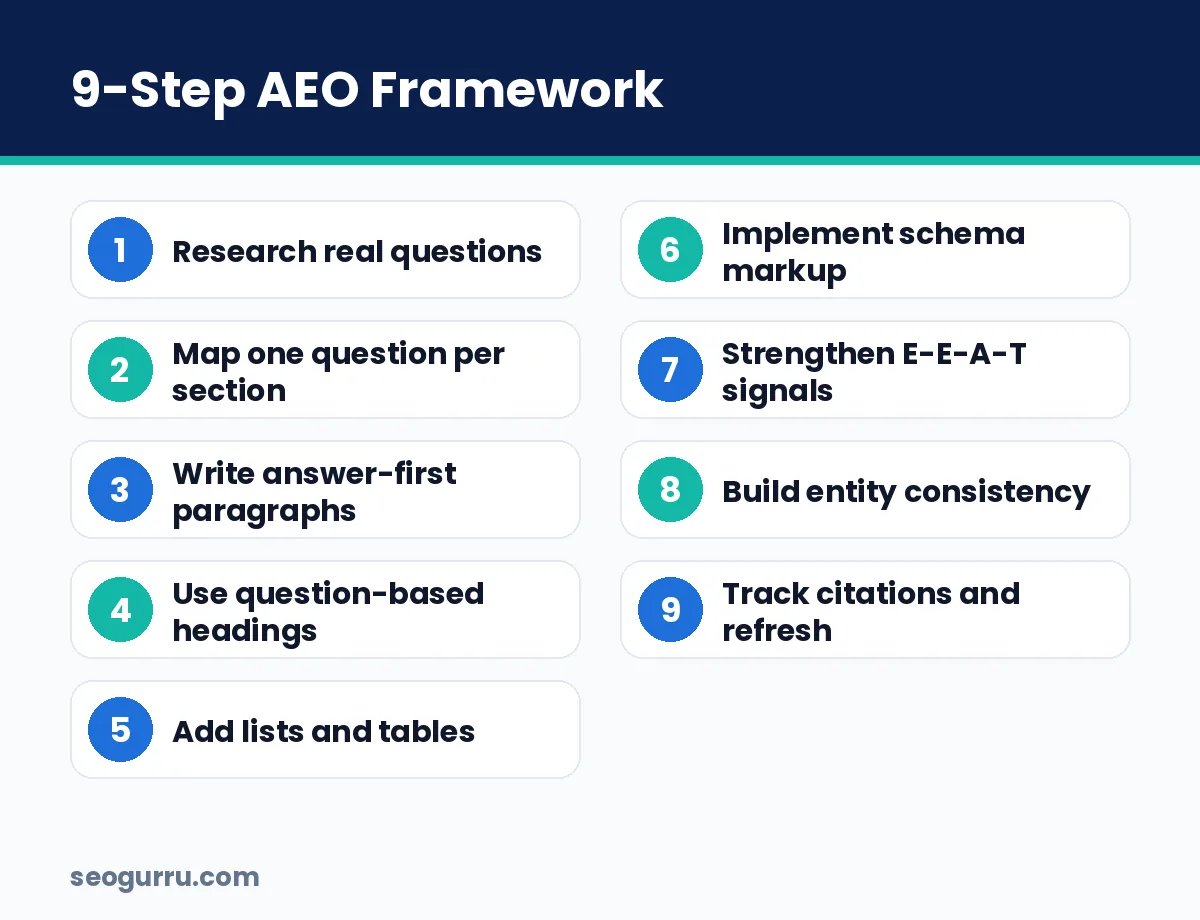
1. Research the questions your audience actually asks
Start with real queries, not guesses. Pull questions from:
- People Also Ask boxes for your main keywords
- Ahrefs or Semrush “Questions” reports
- Google Search Console queries containing who, what, how, why and can
- Sales calls, support tickets and customer emails
- Reddit and Quora threads in your niche
Our keyword research guide walks through how to find and prioritize these queries.
2. Map one clear question to each section
Each H2 or H3 should answer one specific question. This makes your page a set of “answer units” that engines can lift independently. Avoid sections that mix three ideas under a vague heading like “More Information.”
3. Write answer-first paragraphs (the 40–60 word rule)
Directly under each question heading, write a concise answer in 40–60 words. Use the question’s own wording in the first sentence. Then expand with examples, steps and nuance below it.
Example:
- Weak: “There are many factors to consider when thinking about how often to post on a blog…”
- Strong: “Most small business blogs should publish one to two high-quality posts per week. Consistency matters more than volume, because regular publishing helps search engines crawl your site and builds topical depth over time.”
4. Use question-based headings
Headings like “How long does AEO take to work?” match conversational and voice queries word for word. They also help Google generate People Also Ask matches from your page.
5. Add lists, steps and tables
Answer engines love structured formats. Use numbered lists for processes, bullet lists for features, and tables for comparisons. These formats are easy to parse and often appear verbatim in AI answers and featured snippets.
6. Implement schema markup
Structured data tells machines exactly what each part of your page is. For AEO, the most useful types are:
- FAQPage for question-and-answer sections
- HowTo for step-by-step processes
- Article with author and date details
- Organization and LocalBusiness for brand facts
New to structured data? Start with our schema markup guide.
7. Strengthen E-E-A-T signals
Answer engines want to cite sources that are safe to trust. Show real expertise with:
- A named author with a bio and credentials
- First-hand experience, screenshots and original data
- Links to authoritative sources that support your claims
- An updated date and a clear editorial policy
8. Build entity consistency across the web
Make sure your brand name, services, address and key facts are identical on your website, Google Business Profile, social profiles and directories. Consistent entities reduce confusion and increase the chance that AI systems connect answers to your brand. Our entity SEO guide explains this in depth.
9. Track citations and refresh content
Check whether AI tools cite you for your target questions. Search your key questions in ChatGPT, Perplexity and Google, and note which sources appear. Refresh pages every few months with new data, clearer answers and updated examples.
- Put the answer first, then the explanation.
- One question per heading, one answer per section.
- Schema, authorship and consistent brand facts make you safer to cite.
Common AEO Mistakes to Avoid
- Burying the answer under long introductions or stories
- Keyword stuffing questions instead of answering them naturally
- Thin FAQ pages with one-line answers that add no value
- Blocking AI crawlers by accident in robots.txt or a firewall
- Ignoring freshness, so outdated facts get skipped for newer sources
How to Measure AEO Success
AEO results don’t always show up as clicks, so widen your measurement:
- Featured snippet and PAA ownership in your rank tracker
- AI citation checks for a fixed list of priority questions each month
- Branded search growth in Google Search Console
- Referral traffic from chatgpt.com, perplexity.ai and copilot.microsoft.com in GA4
- Assisted conversions from visitors who first found you through an AI answer
Frequently Asked Questions
Is AEO the same as SEO?
No. AEO is a specialized part of SEO. SEO focuses on ranking whole pages, while answer engine optimization focuses on making specific passages easy for AI systems and search features to extract and cite. Strong SEO foundations make AEO far easier.
How long does answer engine optimization take to work?
Featured snippet and AI Overview changes can appear within a few weeks after Google recrawls an updated page. Building enough authority to be cited consistently across ChatGPT and Perplexity usually takes three to six months of steady publishing and brand building.
Do I need schema markup for AEO?
Schema is not strictly required, but it helps. FAQPage, HowTo and Article markup give answer engines clear context about your content, which makes extraction more reliable and can unlock rich results in Google.
What is the ideal length for an AEO answer?
Aim for 40–60 words for the direct answer, written in one or two sentences. Follow it with supporting detail. This length is long enough to be complete and short enough to be quoted.
Conclusion
Answer engine optimization is about making your expertise easy to find, easy to extract and easy to trust. Start by mapping real customer questions, give each one an answer-first section, structure your content with lists and schema, and keep your brand facts consistent everywhere.
The brands that win in AI search won’t be the loudest. They’ll be the clearest. Start with your top ten customer questions this week and rewrite those pages answer-first.
Want expert help? Our AI SEO services team can audit your site for AEO readiness, or you can request a free SEO analysis to see where you stand today.