12 Link Building Strategies That Still Work in 2026
Links are still one of the clearest signals of trust on the web. When a respected website links to you, it’s a public vote of confidence that search engines and AI systems both notice. The challenge is earning those links without spammy shortcuts.
In this guide, you’ll find 12 link building strategies that still work in 2026, from digital PR to simple partner links. Each one includes how it works, who it suits and practical tips to get started.
The most effective link building strategies in 2026 are digital PR, original data studies, expert commentary, guest articles on relevant sites, broken link building, unlinked brand mentions, resource page outreach, partner and supplier links, and creating genuinely useful linkable assets. Focus on relevance and quality over volume.
What Is Link Building?
Link building is the process of getting other websites to link to pages on your site. These links, called backlinks, help search engines discover your content and judge its authority and relevance.
Not all links are equal. One link from a respected industry publication can be worth more than hundreds of links from low-quality directories.
Why Backlinks Still Matter
- Rankings: Links remain a major factor in how Google ranks pages.
- Discovery: Search engines find new pages by following links.
- Referral traffic: Good links send real visitors.
- AI visibility: Brands mentioned and linked across trusted sites are more likely to be cited by AI tools, as we explained in our guide to generative engine optimization.
What makes a good backlink?
- Relevance: the linking site covers a related topic
- Authority: the site has real traffic and a strong reputation
- Editorial placement: the link appears naturally within content
- Descriptive anchor text: clear, natural wording
- Unique domain: a new referring domain beats another link from the same site
The best links are the ones you’d want even if Google didn’t exist.
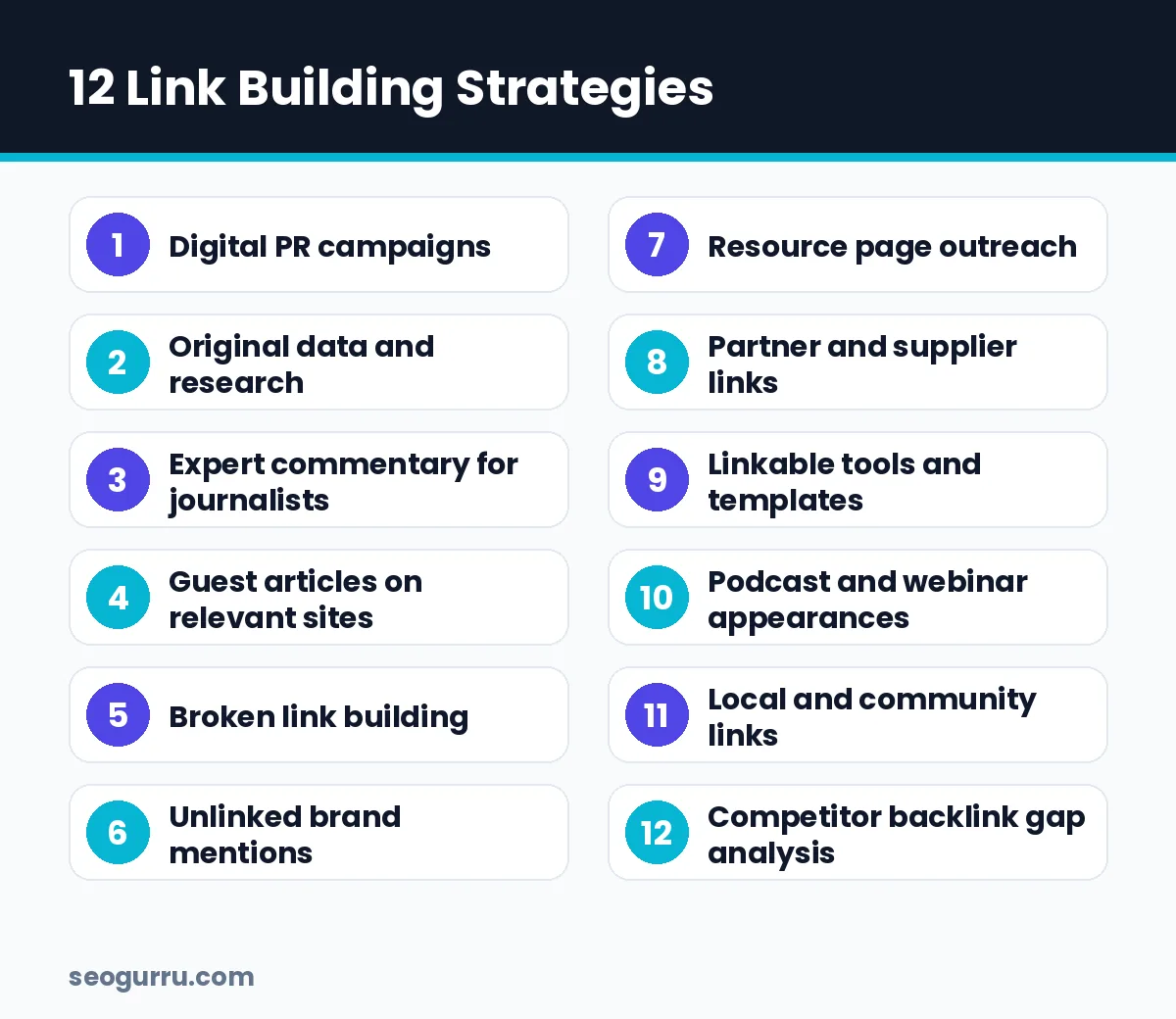
12 Link Building Strategies That Work
1. Digital PR campaigns
Create newsworthy stories, like surveys, trend reports or bold industry insights, and pitch them to journalists. One successful campaign can earn dozens of high-authority news links.
Tip: Tie your story to a current trend or season. Journalists cover what’s timely.
2. Original data and research
Publish statistics that others in your industry will want to cite. Survey your customers, analyze your platform’s data or compile public data into a useful report. Writers love linking to original numbers.
3. Expert commentary for journalists
Platforms like Qwoted, Featured and Help a B2B Writer connect journalists with expert sources. Respond quickly with concise, quotable insights. Over time, this builds both links and brand authority.
4. Guest articles on relevant sites
Write genuinely useful articles for respected sites in your niche. Focus on audience fit, not just domain metrics. Avoid sites that openly sell “guest posts” to anyone; Google treats paid links as spam.
5. Broken link building
Find broken links on relevant pages, then suggest your content as a replacement. Use Ahrefs’ “Broken backlinks” or “Best by links” reports to find dead pages in your niche that still have backlinks.
Example outreach:
“Hi Sarah, I was reading your guide to small business marketing and noticed the link to the ‘SEO basics checklist’ returns a 404. We recently published an updated on-page SEO checklist that might be a helpful replacement. Either way, thanks for the great resource!”
6. Unlinked brand mentions
Search for mentions of your brand, products or team members that don’t include a link. A friendly email asking the author to add a link has a high success rate because they already know you.
7. Resource page outreach
Many sites maintain “useful resources” pages. Search for terms like "[your topic]" + "useful resources" and suggest your best guide or tool where it genuinely fits.
8. Partner and supplier links
Ask suppliers, distributors, software vendors, clients and associations to link to you from partner directories, case studies or testimonial pages. These links are relevant and easy to get.
9. Linkable tools and templates
Free calculators, checklists, templates and generators attract links naturally. A simple “SEO ROI calculator” or a printable checklist can earn links for years.
10. Podcast and webinar appearances
Podcast hosts usually link to their guests’ websites in show notes. Pitch yourself to shows your customers listen to, with clear topic ideas.
11. Local and community links
Sponsor local events, join your chamber of commerce, support charities and get featured in local news. These links strengthen local relevance. Our local SEO checklist includes more ideas.
12. Competitor backlink gap analysis
Use Ahrefs’ Link Intersect or Semrush’s Backlink Gap tool to find sites linking to two or more competitors but not to you. These sites already link to your topic and are good outreach targets.
- Relevance and editorial quality beat raw link volume.
- Create assets worth linking to: data, tools and expert insight.
- Build relationships; one-off spam outreach rarely works.
How to Write Outreach Emails That Get Replies
- Personalize the first line with something specific about their content.
- Keep it short: three to five sentences.
- Lead with value for their readers, not your rankings.
- Make it easy: include the exact URL and suggested placement.
- Follow up once after five to seven days, then move on.
Link Building Mistakes to Avoid
- Buying links or joining link exchanges and private blog networks
- Over-optimized anchor text like exact-match keywords on every link
- Irrelevant links from sites unrelated to your industry
- Mass outreach templates with no personalization
- Ignoring your own content quality, since weak pages don’t earn links
Google’s spam policies explicitly cover link schemes, so shortcuts can lead to ranking drops or manual actions.
How to Measure Link Building Success
- Growth in referring domains, not just total backlinks
- Quality metrics such as Domain Rating and real organic traffic of linking sites
- Ranking improvements for the pages you built links to
- Referral traffic and conversions from linking sites
- Brand mentions in news and AI answers
How Many Backlinks Do You Need?
There’s no magic number. The links you need depend on how competitive your keywords are. A simple way to estimate:
- Search your target keyword and open the top five results in Ahrefs.
- Note how many referring domains each ranking page has.
- Compare with your page. If competitors have 40–60 referring domains and you have 5, links are likely part of the gap.
Remember that content quality, relevance and internal links also matter. Sometimes a better page with fewer links can outrank a weaker page with many links.
Building a sustainable link building routine
Link building works best as a habit, not a one-time project. A simple monthly routine could look like this:
- Week 1: Find and pitch three unlinked brand mentions and two broken link opportunities.
- Week 2: Respond to journalist requests on expert-source platforms.
- Week 3: Pitch one guest article or podcast appearance.
- Week 4: Review new links, update your target list and plan next month’s linkable asset.
Frequently Asked Questions
What is the best link building strategy?
For most businesses, the best link building strategy combines creating genuinely useful content, such as original data or tools, with targeted outreach and digital PR. These approaches earn relevant, editorial links that improve rankings and are safe under Google’s guidelines.
How many backlinks do I need to rank?
It depends on the competition. Analyze the referring domains of pages ranking in the top five for your keyword. Quality and relevance matter more than total count, and strong content and internal linking can reduce the number of links you need.
Is guest posting still effective for link building?
Yes, when done for the right reasons. Writing helpful articles for relevant, respected sites builds authority and earns links. Paying for guest posts or publishing on low-quality sites that accept anything can violate Google’s spam policies.
How long does link building take to show results?
New backlinks usually take a few weeks to a few months to influence rankings, depending on how quickly Google crawls the linking pages and how competitive your keywords are. Consistent link building compounds over time.
Conclusion
Link building in 2026 is about earning trust, not gaming algorithms. Create content worth citing, share it with the right people, and build real relationships in your industry. Mix fast wins like unlinked mentions and partner links with bigger plays like digital PR and original research.
Pick two strategies from this list and commit to them for 90 days. Need a team to scale it safely? Our link building services focus on quality, relevant links, or start with a free SEO analysis.