AI Search Optimization: A Complete Strategy for 2026
Search has split into many front doors. Some customers still type into Google. Others ask ChatGPT, Perplexity, Copilot or Gemini, and many now see AI Overviews before any link. AI search optimization is the strategy that keeps your brand visible no matter which door they use.
This guide pulls everything together into one practical plan. You’ll learn how AI search engines work, the five pillars of AI search optimization, a 90-day roadmap and the metrics to track.
AI search optimization is the practice of making your brand and content discoverable, understandable and citable by AI-powered search tools such as Google AI Overviews, AI Mode, ChatGPT, Perplexity, Copilot and Gemini. It rests on five pillars: technical access, answer-ready content, entity clarity, off-site authority and measurement.
What Is AI Search Optimization?
AI search optimization is the process of improving your visibility in search experiences that use artificial intelligence to generate answers. It combines traditional SEO with answer engine optimization (AEO) and generative engine optimization (GEO).
Google has said that optimizing for its AI features is still SEO. That’s encouraging: you don’t need a whole new playbook. You need to apply SEO fundamentals with a sharper focus on clarity, citations and brand authority.
How AI Search Engines Work
| Platform | Main data source | How results appear |
|---|---|---|
| Google AI Overviews / AI Mode | Google’s search index | Summary with source links |
| ChatGPT search | OAI-SearchBot plus partner search data | Conversational answer with citations |
| Perplexity | Its own crawler and index plus web search | Answer with numbered citations |
| Microsoft Copilot | Bing index | Answer with linked sources |
| Gemini | Google’s search and knowledge systems | Answer with optional source links |
The common pattern is retrieve, then generate. If your content can’t be retrieved, it can’t be cited. If it’s retrieved but hard to quote, a competitor gets the mention.
In AI search, visibility is earned twice: once to be found, and again to be chosen.
The 5 Pillars of AI Search Optimization
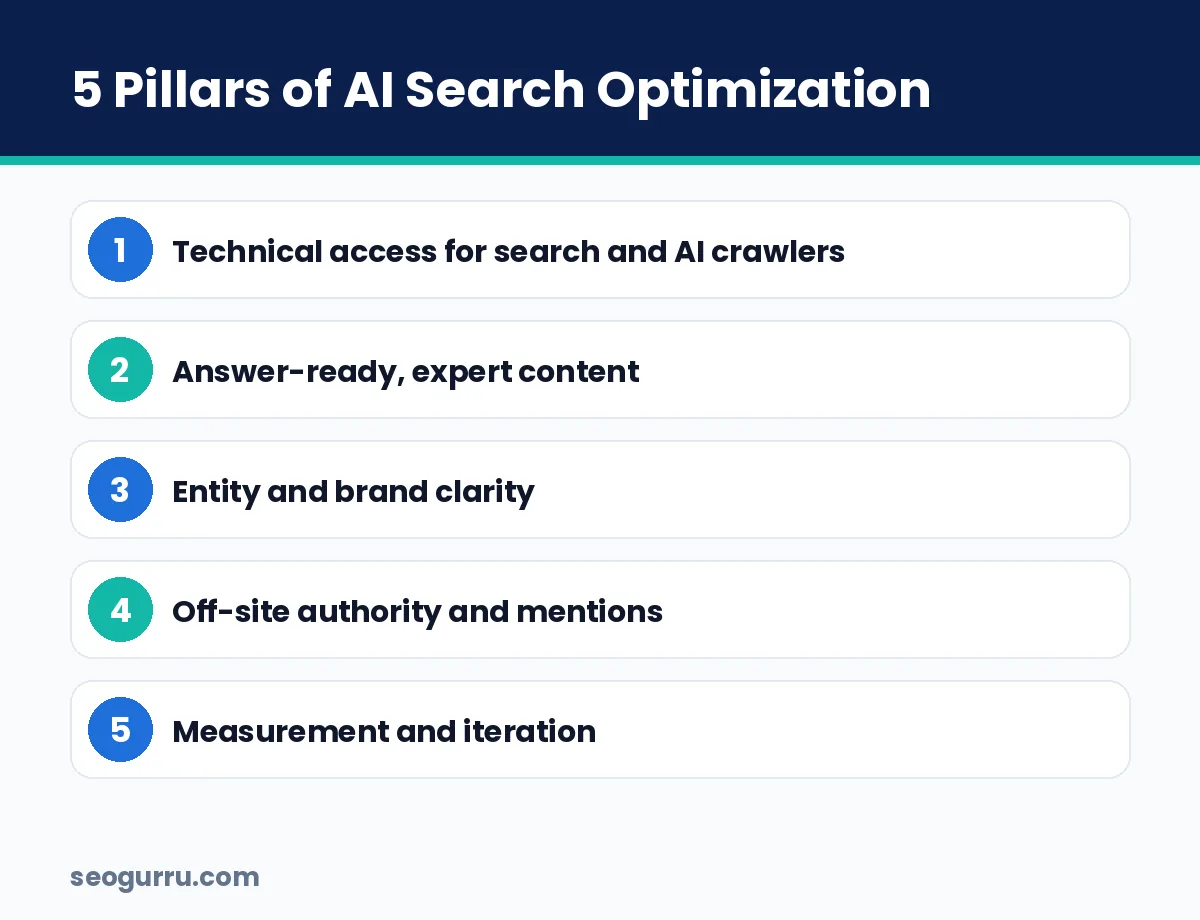
Pillar 1: Technical access
Make sure AI and search crawlers can reach and read your content:
- Allow Googlebot, Bingbot, OAI-SearchBot and PerplexityBot in robots.txt (decide separately on training bots like GPTBot and Google-Extended)
- Check CDN and firewall rules that might block AI bots
- Render key content in HTML, not only through JavaScript
- Keep pages fast and indexable, following our technical SEO checklist
- Submit sitemaps to both Google Search Console and Bing Webmaster Tools
Pillar 2: Answer-ready content
Write content that AI can extract and trust:
- Lead each section with a direct answer
- Use question-based headings that match conversational prompts
- Add specific data, examples and expert quotes
- Use tables for comparisons and numbered lists for steps
- Cover related sub-questions so you match query fan-out
Pillar 3: Entity and brand clarity
AI systems think in entities: people, companies, products and concepts. Help them understand yours:
- A clear About page describing who you are and what you do
- Organization, Person and Product schema with
sameAslinks to your profiles - Consistent brand descriptions across your website, Google Business Profile, LinkedIn and directories
- Named authors with bios and credentials
Our entity SEO guide explains this in detail.
Pillar 4: Off-site authority and mentions
AI tools tend to recommend brands that many trusted sources talk about. Build that presence through:
- Digital PR and expert commentary
- Reviews on Google, G2, Trustpilot, Clutch or industry platforms
- Inclusion in “best of” roundups and comparison articles
- Community participation on Reddit, Quora and industry forums
- High-quality backlinks using proven link building strategies
Pillar 5: Measurement and iteration
Track AI visibility alongside traditional SEO metrics, then adjust based on what you learn. More on this below.
- AI search optimization is SEO plus a sharper focus on being citable.
- Technical access is the gate; content and brand authority win the citation.
- Track AI mentions and referrals, not only rankings.
A 90-Day AI Search Optimization Roadmap
Days 1–30: Foundation
- Audit robots.txt, firewall and rendering for AI crawler access.
- Set up Bing Webmaster Tools and IndexNow.
- Build a list of 30 priority prompts across your products and services.
- Benchmark which brands AI tools mention for those prompts today.
- Add or fix Organization and author schema.
Days 31–60: Content upgrades
- Rewrite your top 10–15 pages with answer-first sections.
- Add comparison tables, FAQs and original data where useful.
- Create missing pages for high-value prompts, such as “best X for Y” or “X vs Y.”
- Refresh outdated statistics and add “last updated” dates.
Days 61–90: Authority building
- Launch one digital PR or data-driven content campaign.
- Pitch inclusion in top roundups for your category.
- Run a review-generation campaign with recent customers.
- Re-test your 30 prompts and compare with your benchmark.
How to Measure AI Search Visibility
- Prompt share of voice: the percentage of priority prompts where your brand is mentioned or cited
- AI referral traffic: sessions from chatgpt.com, perplexity.ai, copilot.microsoft.com and gemini.google.com in GA4
- AI Overview citations: tracked through rank tracking tools that report AI Overview presence
- Branded search volume: growth in Google Search Console
- Conversions from AI referrals: leads and sales attributed to AI sources
Setting up an AI traffic channel in GA4
In GA4, create a custom channel group with a rule that matches session sources containing chatgpt, perplexity, copilot, gemini and claude. Place it above the default “Referral” channel so AI visits are reported separately.
Example prompt-tracking sheet
Keep a simple spreadsheet with these columns: prompt, platform, date tested, brands mentioned, your position in the answer, sources cited and notes. Over a few months, this becomes a clear record of where you’re gaining or losing AI visibility.
AI Search Optimization Mistakes to Avoid
- Treating AI search as separate from SEO and neglecting rankings
- Publishing mass AI-generated content with no original value
- Blocking all AI bots without weighing the visibility trade-off
- Measuring only clicks when AI exposure often shows up as branded search
- Ignoring off-site reputation, which heavily influences AI recommendations
How AI Search Optimization Differs by Business Type
The five pillars apply to everyone, but the emphasis changes:
- Local businesses: focus on Google Business Profile, reviews, consistent citations and clear service-area pages. AI tools often pull local answers from these sources.
- Ecommerce brands: focus on detailed product pages, Product schema, merchant listings, honest comparison content and reviews on third-party marketplaces.
- B2B and SaaS companies: focus on comparison pages, integration pages, documentation, G2 or Capterra reviews and thought leadership that earns mentions.
- Publishers and content sites: focus on original reporting, expert authors, freshness and clear sourcing, since AI tools favor trustworthy primary sources.
Whatever your model, start with the pillar that’s weakest today. For most sites, that’s either technical access or off-site authority.
Frequently Asked Questions
What is AI search optimization?
AI search optimization is the practice of improving how your brand and content appear in AI-powered search experiences, such as Google AI Overviews, ChatGPT, Perplexity and Copilot. It combines SEO fundamentals with answer-ready content, entity clarity and off-site authority so AI tools can find, trust and cite you.
Is AI search optimization different from SEO?
It’s an evolution of SEO rather than a separate discipline. The fundamentals of crawlability, quality content and authority still apply. AI search optimization adds a stronger focus on concise, citable answers, brand mentions across the web and measuring visibility inside AI-generated answers.
Which AI search engine should I optimize for first?
Start with Google AI Overviews and AI Mode because of Google’s reach, then ChatGPT search and Microsoft Copilot (which uses Bing), followed by Perplexity and Gemini. Most optimization work benefits all of them at once.
How do I track my brand in AI search results?
Create a list of priority prompts and test them monthly across AI platforms, recording mentions and citations. Add a custom AI channel in GA4 to track referral traffic, and consider AI visibility tools that monitor brand mentions at scale.
Conclusion
AI search optimization isn’t a trend to wait out. It’s how search works now. The good news is that the winning formula builds on what already works: accessible websites, genuinely helpful content, clear brand identity and a strong reputation across the web.
Use the five pillars and 90-day roadmap above to get started. If you’d rather have experts lead it, our AI SEO services cover every pillar, or begin with a free SEO analysis to benchmark your AI visibility.