Zero-Click Searches: What They Are and How to Win Without the Click
You rank on page one. Your impressions are up. But clicks are flat or falling. If that sounds familiar, you’re seeing the effect of zero-click searches, where people get their answer directly on the results page and never visit a website.
This doesn’t mean SEO is dead. It means the goal has changed. In this guide, you’ll learn what zero-click searches are, why they’re growing, which queries they affect most, and eight strategies to win visibility, trust and customers without relying on every click.
A zero-click search is a search that ends without the user clicking any result, because the answer appears directly on the search page through AI Overviews, featured snippets, knowledge panels, local packs or other features. To win, aim to be the source of those answers, build brand recall, and target queries where clicks still happen.
What Are Zero-Click Searches?
A zero-click search happens when a user searches, gets what they need from the search results page itself, and leaves or searches again without clicking through to any website.
Examples include:
- Asking “what time is it in Tokyo” and reading the answer at the top
- Searching “weather tomorrow” and checking the forecast widget
- Looking up a restaurant and calling directly from the local pack
- Reading an AI Overview that fully answers a “how to” question
How Common Are Zero-Click Searches?
A widely cited 2024 study by SparkToro and Datos found that roughly 58.5% of US Google searches ended without a click, and only about 360–374 of every 1,000 searches resulted in a click to the open web. Since then, the expansion of AI Overviews and AI Mode has added even more on-page answers.
Zero-click doesn’t mean zero value. It means the value moved onto the results page.
Why Zero-Click Searches Are Growing
- AI Overviews and AI Mode summarize answers from multiple sources.
- Featured snippets pull a direct answer from one page.
- Knowledge panels show facts about people, brands and places.
- Local packs let people call, get directions or book directly.
- Instant answers cover weather, sports, calculations, conversions and definitions.
- Mobile search encourages quick answers over browsing.
- AI chat tools answer questions without showing a results page at all.
Which Queries Are Most Affected?
| Query type | Zero-click risk | Example |
|---|---|---|
| Simple facts and definitions | Very high | “what is a meta description” |
| Quick calculations and conversions | Very high | “100 usd to pkr” |
| Local “near me” searches | High (calls/directions) | “dentist near me” |
| How-to questions | Medium to high | “how to reset a router” |
| Comparisons and research | Medium | “best crm for small business” |
| Transactional searches | Low | “buy standing desk” |
| Complex B2B research | Low | “enterprise seo platform pricing” |
The pattern is simple: the easier the answer, the less reason to click.
How Zero-Click Searches Affect SEO
- Fewer clicks for informational content, even when rankings hold
- Higher impressions in Google Search Console
- Lower average CTR, especially for position one on question queries
- More brand exposure if you’re the cited source
- More qualified clicks, because people who click want more depth
8 Strategies to Win in a Zero-Click World
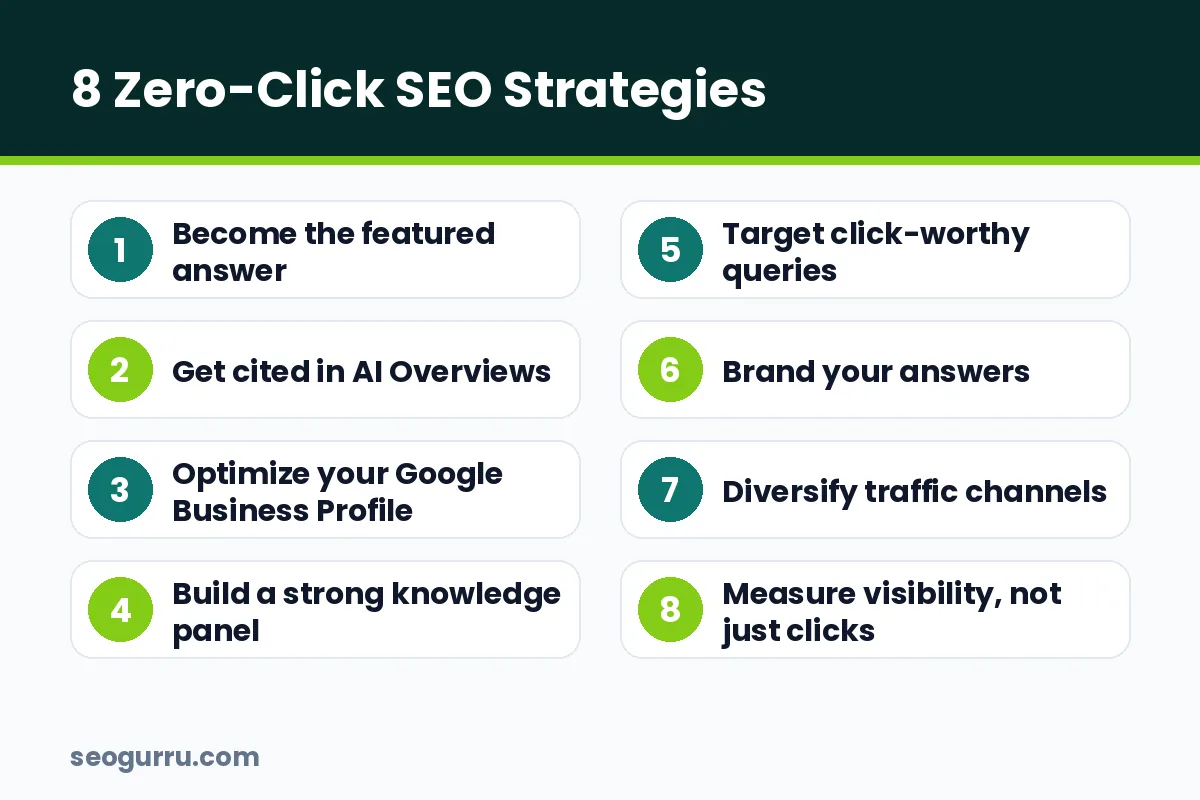
1. Become the featured answer
Structure content to win featured snippets and People Also Ask boxes. Use question headings, 40–60 word answers, numbered steps and tables. Our answer engine optimization guide shows exactly how.
2. Get cited in AI Overviews
Being one of the cited sources keeps your brand visible even when users don’t click. Follow the steps in our AI Overviews SEO guide: rank first, answer clearly and cover related sub-questions.
3. Optimize your Google Business Profile
For local businesses, zero-click often means a phone call or a direction request, which are valuable outcomes. Complete every field, post updates, add photos and earn reviews. See our local SEO checklist.
4. Build a strong knowledge panel
Help Google understand your brand as an entity with consistent information, Organization schema and profiles on trusted platforms. A rich knowledge panel builds credibility on branded searches.
5. Target queries where clicks still happen
Shift some effort to keywords that need depth, comparison or action, such as:
- “Best [product] for [use case]”
- “[Service] pricing” and “cost of
“
- “[Tool] tutorial” and “templates”
- Complex, multi-step problems
6. Brand your answers
Put your brand name naturally into key definitions, frameworks and data. Name your methods (“the SEOGurru 5-Pillar Framework”) and publish original statistics. When AI or snippets quote you, your brand travels with the answer.
7. Diversify your traffic channels
Don’t rely on Google clicks alone. Build an email list, grow on YouTube, LinkedIn or other social platforms, and earn mentions in newsletters and podcasts. Zero-click exposure works best when people can find you again elsewhere.
8. Measure visibility, not just clicks
Track impressions, featured snippet ownership, AI citations, branded search growth and conversions. A drop in CTR with rising brand searches may actually signal success.
- Zero-click searches shift value from clicks to visibility.
- Be the answer: snippets, AI Overviews and local packs.
- Target deeper queries and diversify channels for clicks that convert.
How to Spot Zero-Click Impact in Search Console
- Open Performance → Search results and compare the last three months with the previous period.
- Look for queries where impressions rose but CTR fell while average position stayed stable.
- Search those queries manually to see which SERP features appear.
- Group affected queries by intent, then decide whether to optimize for the feature or shift effort to click-worthy topics.
Should You Still Create Informational Content?
Yes, but with a clear purpose. Informational content builds topical authority, earns links, feeds AI answers and introduces your brand early. Just make sure each piece also offers depth that a summary can’t: templates, tools, original data, expert opinion or step-by-step walkthroughs that reward the click.
Make the click worth it
When someone does click from a zero-click-style results page, they want more than the summary. Reward them with:
- Downloadable templates or checklists they can use right away
- Interactive tools, such as calculators or graders
- Original data and charts they can’t get anywhere else
- Expert opinions and real examples that a summary leaves out
- Clear next steps that guide them toward your product or service
Pages built this way earn clicks from the most motivated searchers, and those visitors tend to convert better.
Zero-Click Searches and Local Businesses
For local businesses, zero-click can be good news. A searcher who calls you directly from the map pack never visits your website, but they still become a lead. That’s why phone calls, direction requests and booking clicks in your Google Business Profile Performance report deserve the same attention as website sessions.
Track these actions monthly and compare them with organic website leads. Many local businesses find that most of their search-driven leads now come from the profile, not the website.
Frequently Asked Questions
What is a zero-click search?
A zero-click search is a search query that ends without the user clicking on any search result. The user finds the answer directly on the results page through features like AI Overviews, featured snippets, knowledge panels, local packs or instant answers.
Are zero-click searches bad for SEO?
They reduce website clicks for some queries, especially simple informational ones. However, they also create brand visibility when your content is the cited answer. Businesses that adapt by targeting featured answers and click-worthy queries can still grow.
How do I optimize for zero-click searches?
Structure content to win featured snippets and AI Overview citations, optimize your Google Business Profile, build a strong brand entity, put your brand name into quotable answers, and focus some effort on queries that require deeper research or action.
How do I measure zero-click search performance?
Track impressions, featured snippet and AI Overview appearances, branded search volume, Google Business Profile actions such as calls and direction requests, and conversions, rather than relying only on organic clicks.
Conclusion
Zero-click searches are here to stay, but they don’t make SEO pointless. They change what winning looks like. Be the answer people see, make your brand part of that answer, and focus your click-driving efforts on deeper, high-intent topics.
Start by finding queries in Search Console where impressions grow but clicks don’t, then decide whether to win the feature or shift focus. Need a strategy built for modern search? Our SEO services can help, or begin with a free SEO analysis.