15 SEO KPIs to Track in 2026 (and How to Measure Them)
Rankings went up. Traffic went down. Leads stayed the same. Is your SEO working or not? Without the right SEO KPIs, it’s impossible to tell, and even harder to convince your boss or client.
This guide covers the 15 SEO KPIs worth tracking in 2026, grouped by what they tell you. For each one, you’ll learn what it means, why it matters and exactly where to measure it.
The most important SEO KPIs are organic conversions, organic revenue or pipeline, organic traffic, non-branded clicks, keyword rankings, click-through rate, impressions, referring domains, indexed pages, Core Web Vitals and AI visibility. Tie every KPI back to a business goal.
What Are SEO KPIs?
SEO KPIs (key performance indicators) are measurable values that show how effectively your search engine optimization efforts help you reach business goals. A metric is any number you can track. A KPI is a metric tied to a specific objective.
For example, “organic sessions” is a metric. “Increase organic leads by 30% this year” is a KPI-driven goal.
How to Choose the Right SEO KPIs
Use a simple three-level framework:
- Business KPIs: revenue, leads, pipeline, sign-ups
- Engagement KPIs: conversions rate, engaged sessions, returning visitors
- Visibility KPIs: rankings, impressions, CTR, AI citations, backlinks
Report business KPIs to leadership, and use visibility KPIs to diagnose and improve.
Leadership doesn’t buy rankings. They buy results that rankings make possible.
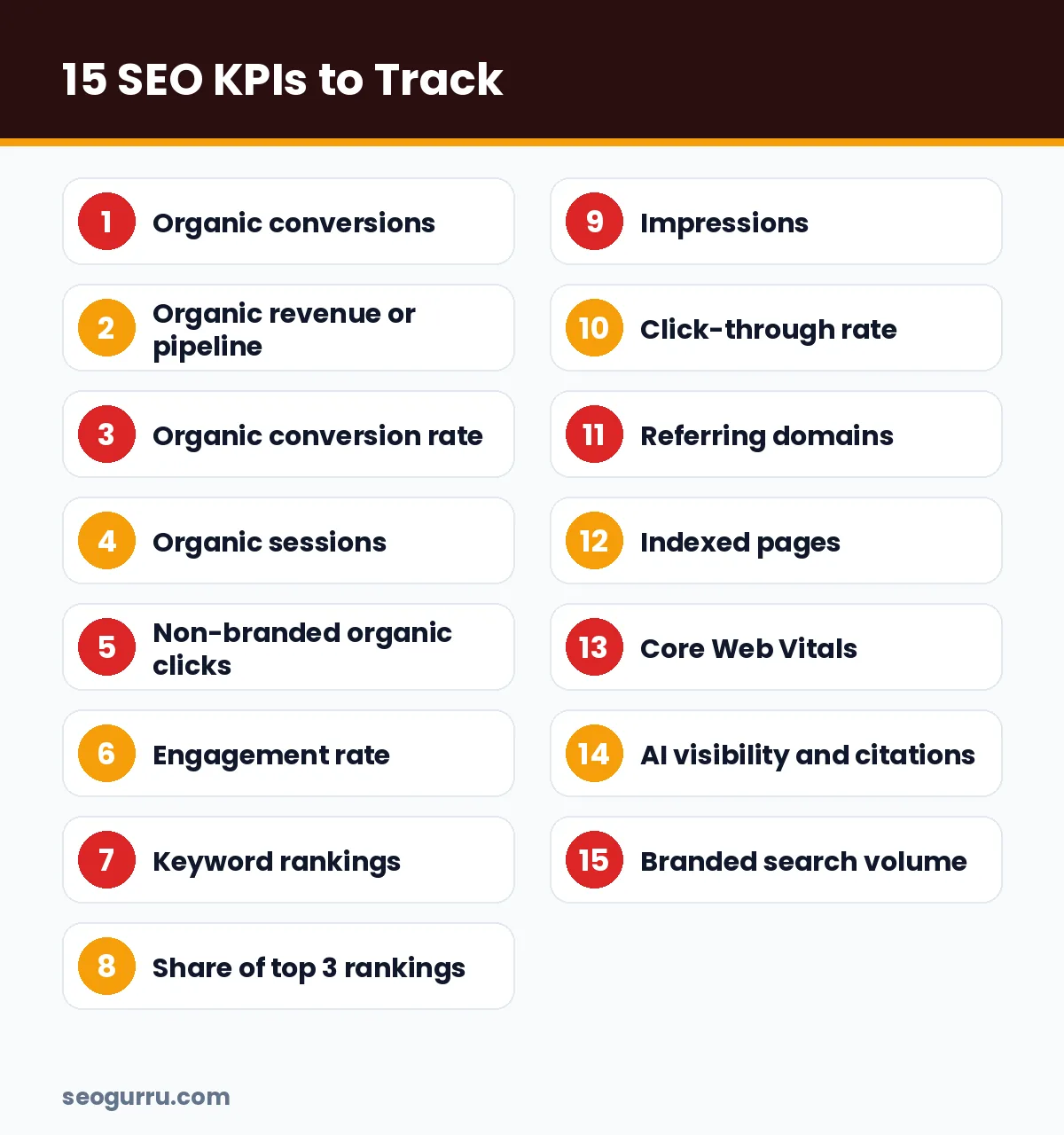
15 SEO KPIs to Track
Business KPIs
1. Organic conversions
The number of leads, sign-ups, calls or purchases from organic search. In GA4, open Reports → Acquisition → Traffic acquisition, filter by “Organic Search” and view key events.
2. Organic revenue or pipeline
For ecommerce, track revenue from organic sessions in GA4. For B2B, connect GA4 or your forms to your CRM so you can see opportunities and closed deals from organic leads.
3. Organic conversion rate
Organic conversions divided by organic sessions. A rising conversion rate means you’re attracting the right visitors, not just more of them.
Engagement KPIs
4. Organic sessions
Total visits from organic search. It’s useful for trends but shouldn’t be your only KPI, because traffic without conversions is vanity.
5. Non-branded organic clicks
Clicks from searches that don’t include your brand name. This shows how well you attract new audiences. In Google Search Console, filter queries to exclude your brand terms.
6. Engagement rate
GA4’s engagement rate shows the share of sessions that lasted 10+ seconds, had a key event or viewed two or more pages. Low engagement on a ranking page often signals an intent mismatch.
Visibility KPIs
7. Keyword rankings
Track positions for a focused set of priority keywords in tools like Ahrefs or Semrush. Group them by topic or funnel stage for clearer insights.
8. Share of top 3 rankings
The number or percentage of tracked keywords ranking in positions 1–3, where most clicks happen. It’s a sharper KPI than average position.
9. Impressions
How often your pages appear in Google results, from Search Console. Rising impressions show growing visibility, even before clicks catch up.
10. Click-through rate (CTR)
Clicks divided by impressions. Low CTR on high-ranking pages can mean weak titles and meta descriptions or heavy zero-click features. Learn more in our guide to zero-click searches.
11. Referring domains
The number of unique websites linking to you. Track it in Ahrefs or Semrush. Quality and relevance matter more than raw growth. See our link building strategies for ways to grow it.
12. Indexed pages
In Search Console’s Pages report, monitor how many important pages are indexed and why others aren’t. Sudden drops can signal technical problems.
13. Core Web Vitals
Track the share of URLs with “Good” LCP, INP and CLS in Search Console. Our Core Web Vitals guide explains the thresholds.
14. AI visibility and citations
Track how often your brand is mentioned or cited in AI Overviews, ChatGPT, Perplexity and Copilot for a fixed list of prompts. Also track AI referral sessions in GA4.
15. Branded search volume
Growth in searches for your brand name, visible in Search Console and keyword tools. It reflects awareness built through SEO, AI exposure and other marketing.
- Lead with business KPIs: conversions, revenue and pipeline.
- Use visibility KPIs to diagnose what’s working and what isn’t.
- Add AI visibility and branded search as modern SEO KPIs.
SEO KPIs by Business Type
| Business type | Top 3 KPIs |
|---|---|
| Local service business | Calls and form leads, Google Business Profile actions, local rankings |
| Ecommerce store | Organic revenue, conversion rate, category page rankings |
| B2B or SaaS | Organic pipeline, demo requests, non-branded clicks |
| Publisher or blog | Organic sessions, engagement rate, ad or affiliate revenue |
How Often Should You Review SEO KPIs?
- Weekly: technical health and sudden drops (Search Console errors, indexing)
- Monthly: traffic, rankings, CTR, conversions and links
- Quarterly: revenue, pipeline, AI visibility and strategy changes
SEO moves slowly, so judge progress over months, not days. Our upcoming guide to SEO reporting shows how to turn these KPIs into a clear monthly report.
Building a Simple SEO KPI Dashboard
You don’t need expensive software to track SEO KPIs. A free Looker Studio dashboard can pull GA4 and Search Console data into one view. Include:
- A scorecard row for organic conversions, sessions, clicks and CTR
- A 13-month trend chart so you can compare year over year
- A table of top landing pages with sessions and conversions
- A table of top queries with clicks, impressions and position
- A filter to switch between branded and non-branded queries
Share the dashboard with stakeholders so they can check progress anytime without waiting for a monthly email.
Common SEO KPI Mistakes
- Reporting only rankings and traffic
- Ignoring branded vs non-branded differences
- Comparing months without accounting for seasonality
- Setting targets with no baseline
- Changing KPIs every quarter so trends can’t be compared
How to Set SEO KPI Targets
Good targets are realistic, time-bound and based on your own data. Use this simple process:
- Set a baseline. Record the last 12 months of each KPI so you understand seasonality.
- Look at opportunity. Estimate how much traffic you could gain by moving priority keywords into the top three positions.
- Factor in resources. A team publishing eight pages a month can set more ambitious targets than one publishing two.
- Set quarterly milestones. Break annual goals into quarterly checkpoints so you can adjust early.
Example: “Increase non-branded organic clicks from 4,000 to 6,000 per month and organic demo requests from 20 to 32 per month by the end of Q4.”
Leading vs lagging indicators
Some KPIs move first and predict later results. Impressions, new rankings in positions 11–20 and new referring domains are leading indicators. Conversions and revenue are lagging indicators. When stakeholders get impatient, show leading indicators to prove momentum while lagging ones catch up.
Frequently Asked Questions
What are the most important SEO KPIs?
The most important SEO KPIs are organic conversions, organic revenue or pipeline, non-branded organic clicks, keyword rankings in the top three positions, click-through rate and referring domains. Together, they show both business impact and the visibility that drives it.
How do I measure SEO KPIs?
Use Google Analytics 4 for traffic, engagement and conversions; Google Search Console for impressions, clicks, CTR, indexing and Core Web Vitals; and tools like Ahrefs or Semrush for rankings and backlinks. Connect analytics to your CRM for pipeline and revenue.
What is a good organic CTR?
It varies by position and SERP features. Top-ranking results can earn 20–40% CTR on queries without heavy SERP features, while results below AI Overviews or ads often earn less. Compare your CTR with your own historical data rather than a universal benchmark.
How long before SEO KPIs improve?
Leading indicators such as impressions and rankings often improve within two to three months. Business KPIs like leads and revenue usually take four to twelve months, depending on competition and how consistently you invest in SEO.
Conclusion
The right SEO KPIs turn SEO from a mystery into a measurable growth channel. Start with business outcomes, add engagement and visibility metrics to understand what drives them, and include modern measures like AI visibility and branded search.
Pick five KPIs from this list, set baselines and review them monthly. If you’d like a team to track and improve them for you, explore our SEO services or request a free SEO analysis.