Topical Authority: How to Build It and Rank for Entire Topics
Why does one website rank for hundreds of keywords in a niche while another, with similar backlinks, barely ranks for any? Often the answer is topical authority: search engines trust sites that cover a subject deeply and consistently.
In this guide, you’ll learn what topical authority is, why it matters more than ever with AI search, and a seven-step process to build it with topical maps, pillar pages and topic clusters.
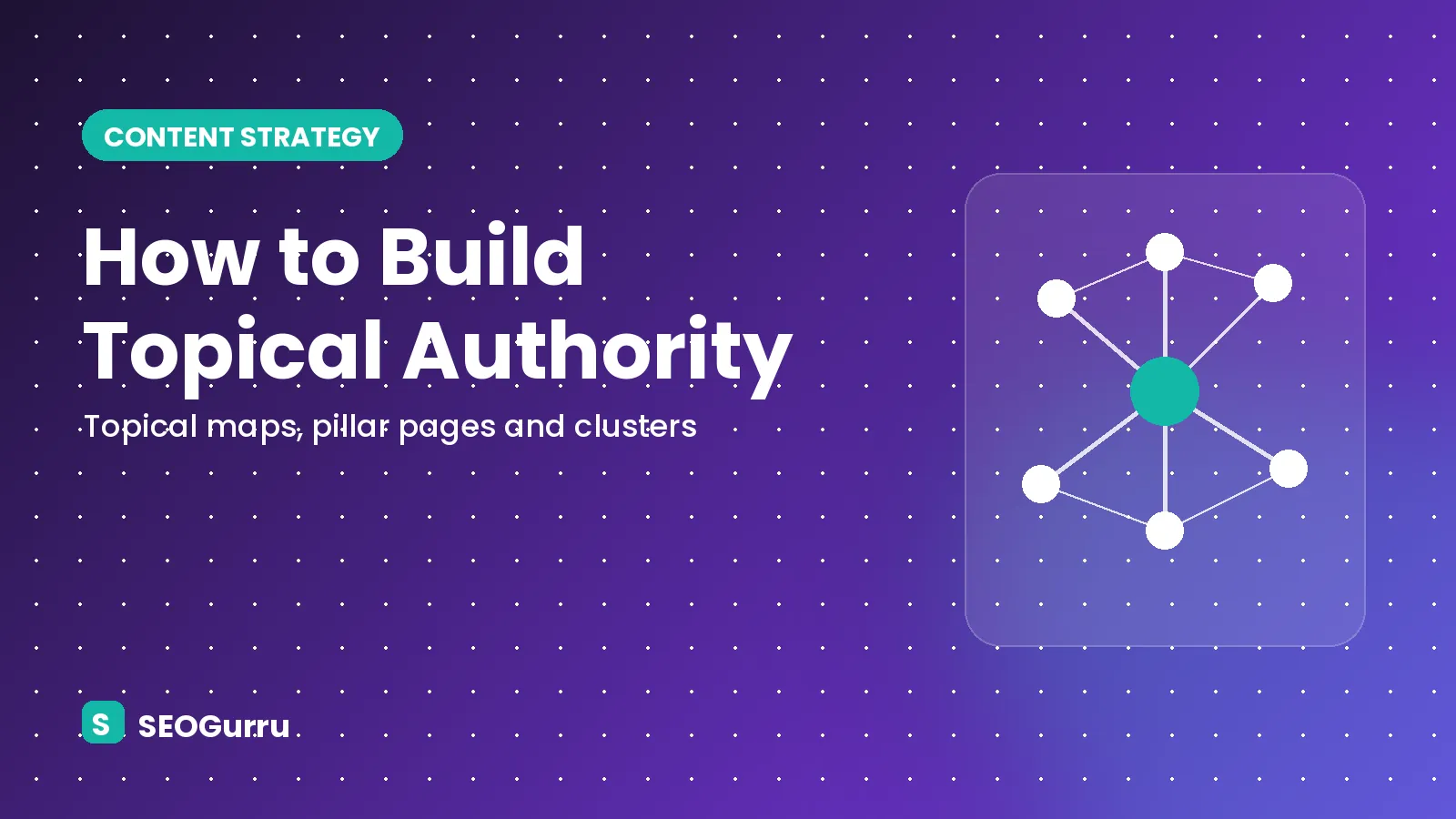
Topical authority is the perceived expertise a website has on a specific subject, built by covering that topic comprehensively through interlinked content. Build it by mapping all subtopics, creating pillar pages and supporting cluster articles, linking them together and updating them regularly.
What Is Topical Authority?
Topical authority is a measure of how thoroughly and reliably a website covers a particular subject. A site with strong topical authority answers the main questions, the follow-up questions and the niche questions about its topic, so search engines see it as a go-to source.
It’s not an official Google metric with a single score. It’s a concept that describes how Google’s systems appear to reward depth and consistency on a topic.
Topical authority vs domain authority
- Domain authority (a third-party metric from tools like Moz or Ahrefs’ Domain Rating) mainly reflects backlink strength across a whole site.
- Topical authority reflects depth and relevance on a specific subject.
A small niche site can outrank a big general site on its topic because it has more topical authority, even with fewer links.
Google doesn’t just ask “is this page good?” It asks “does this site truly know this subject?”
Why Topical Authority Matters
- More rankings: covering a topic deeply helps you rank for many related long-tail keywords.
- Faster indexing and ranking for new content within the same topic.
- Stronger E-E-A-T signals because your expertise is visible across many pages.
- AI search visibility: AI tools favor sources that consistently explain a subject well, as we covered in our AI search optimization guide.
- Better user experience: readers find answers to follow-up questions on your site.
How to Build Topical Authority in 7 Steps
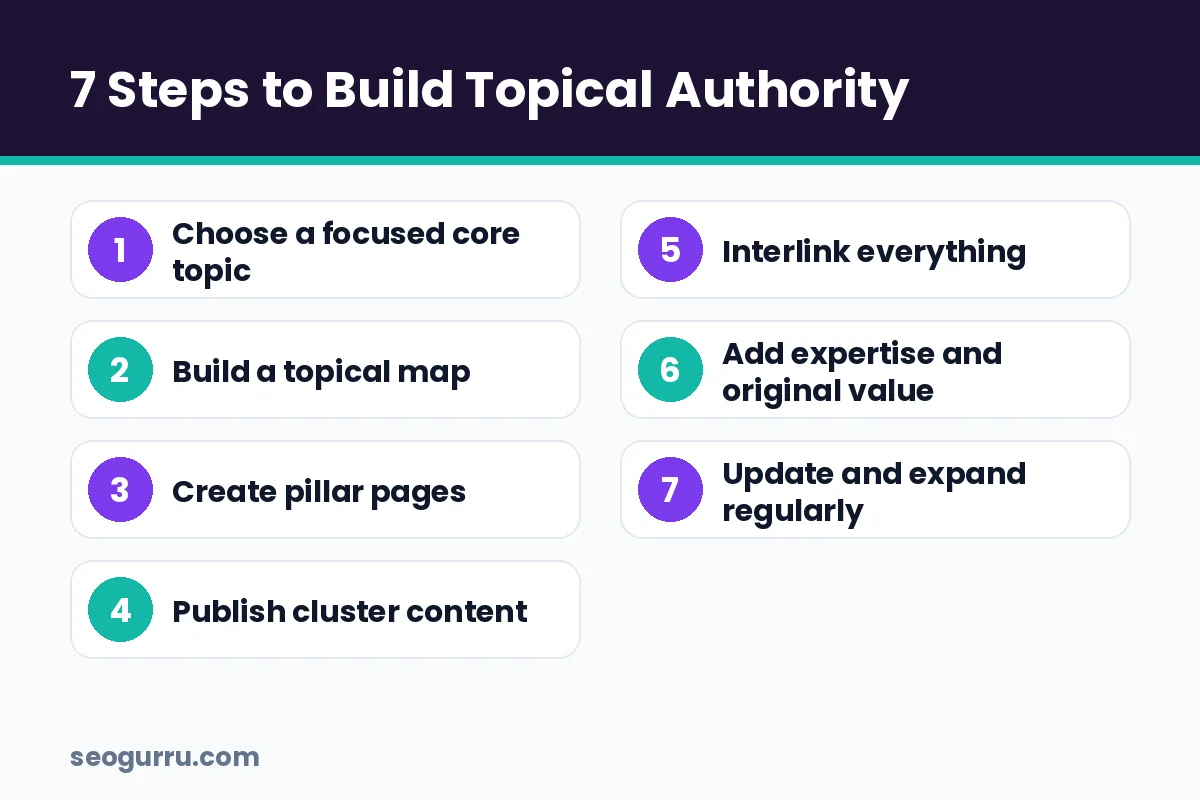
1. Choose a focused core topic
Pick a topic closely tied to your business and narrow enough that you can cover it fully. “Marketing” is too broad. “Local SEO for dental practices” is focused.
2. Build a topical map
A topical map is a structured list of every subtopic and question your audience might search. Build it from:
- Keyword tools (Ahrefs Matching Terms, Semrush Keyword Magic Tool)
- People Also Ask and related searches
- Competitor sitemaps and top pages
- Customer questions from sales and support
- Forums like Reddit and Quora
Group keywords by search intent and subtopic, not just by shared words. Our keyword research guide explains how to collect and group terms.
Example topical map (partial) for “email marketing”:
| Pillar | Clusters |
|---|---|
| Email marketing basics | what is email marketing, benefits, email marketing vs social media |
| List building | lead magnets, signup forms, double opt-in, list growth tactics |
| Email copywriting | subject lines, preview text, CTAs, personalization |
| Deliverability | SPF/DKIM/DMARC, spam filters, sender reputation |
| Automation | welcome series, abandoned cart, re-engagement flows |
| Analytics | open rate, click rate, benchmarks, A/B testing |
3. Create pillar pages
A pillar page is a comprehensive overview of a main subtopic. It covers the essentials and links to more detailed cluster articles. Pillars often target broader, higher-volume keywords.
4. Publish cluster content
Cluster articles go deep on specific questions. Each should target one primary keyword and intent. Publish clusters in batches so you complete a subtopic rather than spreading thin across many.
5. Interlink everything
- Link each cluster article to its pillar
- Link the pillar to every cluster
- Link related clusters to each other where it helps readers
Use descriptive anchor text. Our internal linking strategy guide covers this in depth.
6. Add expertise and original value
Topical authority isn’t just about volume. Each page should add something real: first-hand experience, original examples, data, expert quotes or clear frameworks. Thin pages that repeat what everyone else says can weaken your authority.
7. Update and expand regularly
Refresh pillars and top clusters every few months, fill gaps you discover in Search Console, and add new subtopics as your industry evolves.
- Depth on one topic beats shallow coverage of many.
- A topical map keeps your content focused and complete.
- Interlinking turns separate posts into a connected knowledge hub.
How Topical Authority Connects to Semantic SEO
Search engines understand meaning, not just keywords. Covering related entities, concepts and questions helps them see the full context of your content. This approach, called semantic SEO, works hand-in-hand with topical authority. Our entity SEO guide explains how entities fit in.
How Long Does It Take to Build Topical Authority?
For a new site, expect three to twelve months of consistent publishing to see strong topical signals, depending on competition. A focused cluster of 20–40 high-quality articles on one subject can make a noticeable difference in that time.
How to Measure Topical Authority
There’s no single score, but these signals show progress:
- Growing number of ranking keywords within the topic (Ahrefs or Semrush, filtered by folder or topic)
- Faster ranking for newly published cluster articles
- Rising impressions for topic-related queries in Search Console
- More featured snippets and AI citations on topic questions
- Natural backlinks to cluster content from other sites in your niche
Common Topical Authority Mistakes
- Publishing on too many unrelated topics at once
- Creating multiple thin posts that target the same keyword (cannibalization)
- Forgetting internal links between pillars and clusters
- Using AI to mass-produce generic content without original insight
- Never updating older content
Topical Authority Example: A Small Business Case
Imagine a local bakery website that wants to rank for cake-related searches. Instead of random posts, it builds a “custom cakes” hub:
- Pillar: “Custom Cakes: The Complete Guide to Ordering the Perfect Cake”
- Clusters: wedding cake sizes, cake flavor combinations, how far in advance to order, fondant vs buttercream, cake pricing explained, dietary options (gluten-free, vegan)
- Service pages: wedding cakes, birthday cakes, corporate cakes, each linked from the relevant clusters
Within months, the bakery ranks for dozens of long-tail cake questions, gets cited in AI answers about cake planning, and funnels readers to its order pages. That’s topical authority turning into revenue.
How many articles do you need?
There’s no fixed number. Small, specific topics may need 10–15 articles, while broad subjects can require 50 or more. Use your topical map as the guide: you’re done with a subtopic when you’ve covered every meaningful question your audience asks about it, not when you hit a number.
Topical authority and AI search
AI tools often cite websites that consistently explain a subject well across many pages. When your site answers both the main question and its follow-ups, it becomes a reliable source for query fan-out in AI Mode and a safer recommendation in tools like ChatGPT. That makes topical depth one of the best long-term investments for AI visibility.
Frequently Asked Questions
What is topical authority in SEO?
Topical authority is the expertise and trust a website earns on a specific subject by covering it comprehensively with high-quality, interlinked content. Sites with strong topical authority tend to rank for more related keywords and rank new content faster.
How do I build topical authority quickly?
Choose one focused topic, build a topical map, then publish a pillar page and a batch of in-depth cluster articles that answer every key question. Interlink them carefully and promote them to earn links. Concentrated effort on one topic works faster than spreading content thin.
Are topic clusters still effective?
Yes. Topic clusters organize content in a way that helps both users and search engines understand your expertise. Combined with strong internal linking and original insights, they remain one of the most reliable ways to build topical authority.
Can a small website beat big sites with topical authority?
Yes. A small site that covers a narrow topic more deeply and helpfully than large general sites can outrank them for many niche and long-tail keywords, even with fewer backlinks.
Conclusion
Topical authority rewards focus. Choose a subject you know well, map every question your audience asks, build pillars and clusters, connect them with internal links and keep improving them. Over time, search engines and AI tools will see your site as the go-to source.
Start by mapping one topic this week and listing 20 cluster ideas. Want help building a full content strategy? Our content optimization and SEO consulting services can guide you, or start with a free SEO analysis.