AI Overviews SEO: How to Rank in Google’s AI Overviews
Search “how to lower cholesterol naturally” on Google, and you’ll probably see an AI-generated summary before any website. That summary is an AI Overview, and the handful of sites it cites are getting the attention everyone else is losing.
This guide explains how AI Overviews work, how they affect your traffic, and the SEO steps that improve your chances of being cited in AI Overviews and Google’s AI Mode. No hacks, just practical tactics based on how Google says these features work.
To rank in Google AI Overviews, you first need to rank well organically, because AI Overviews draw on Google’s index and core ranking systems. Then make your content easy to cite: answer questions directly, cover related sub-questions, use clear structure, show real expertise and keep content fresh.
What Are Google AI Overviews?
Google AI Overviews are AI-generated summaries that appear at the top of some search results. They combine information from multiple web pages into one answer and display links to the sources used.
AI Overviews grew out of Google’s Search Generative Experience (SGE) experiment and launched broadly in the US in 2024. They’ve since expanded to many countries and languages.
What is Google AI Mode?
AI Mode is a separate, more conversational search experience inside Google. It handles longer, multi-part questions and follow-ups. It uses a technique Google calls query fan-out: it breaks your question into many related sub-searches, runs them at the same time, and combines the results into one response with links.
How AI Overviews Choose Sources
Google’s documentation on AI features and your website is clear: there are no special requirements to appear in AI Overviews beyond normal SEO best practices. To be eligible, a page must be indexed and eligible to show a snippet in Google Search.
In practice, cited pages tend to share these traits:
- They already rank on page one for the query or a closely related sub-query
- They contain a concise passage that directly answers part of the question
- They come from trusted, relevant sources with clear expertise
- They add useful detail, such as steps, comparisons or data
- They are accessible: crawlable, fast and not blocked by snippet controls
AI Overviews don’t replace rankings. They reward the pages that rank and explain things best.
How AI Overviews Affect Organic Traffic
Several industry studies, including research from Ahrefs and Seer Interactive, have found that click-through rates for top organic results drop noticeably when an AI Overview appears. Informational queries are hit hardest.
But there’s another side. Pages cited inside the AI Overview often see better click-through rates than uncited pages ranking below it. And clicks from AI Overviews tend to come from users who want more depth, which can mean higher engagement.
The takeaway: you can’t stop AI Overviews, but you can compete to be cited inside them.
How to Rank in AI Overviews: 8 Steps
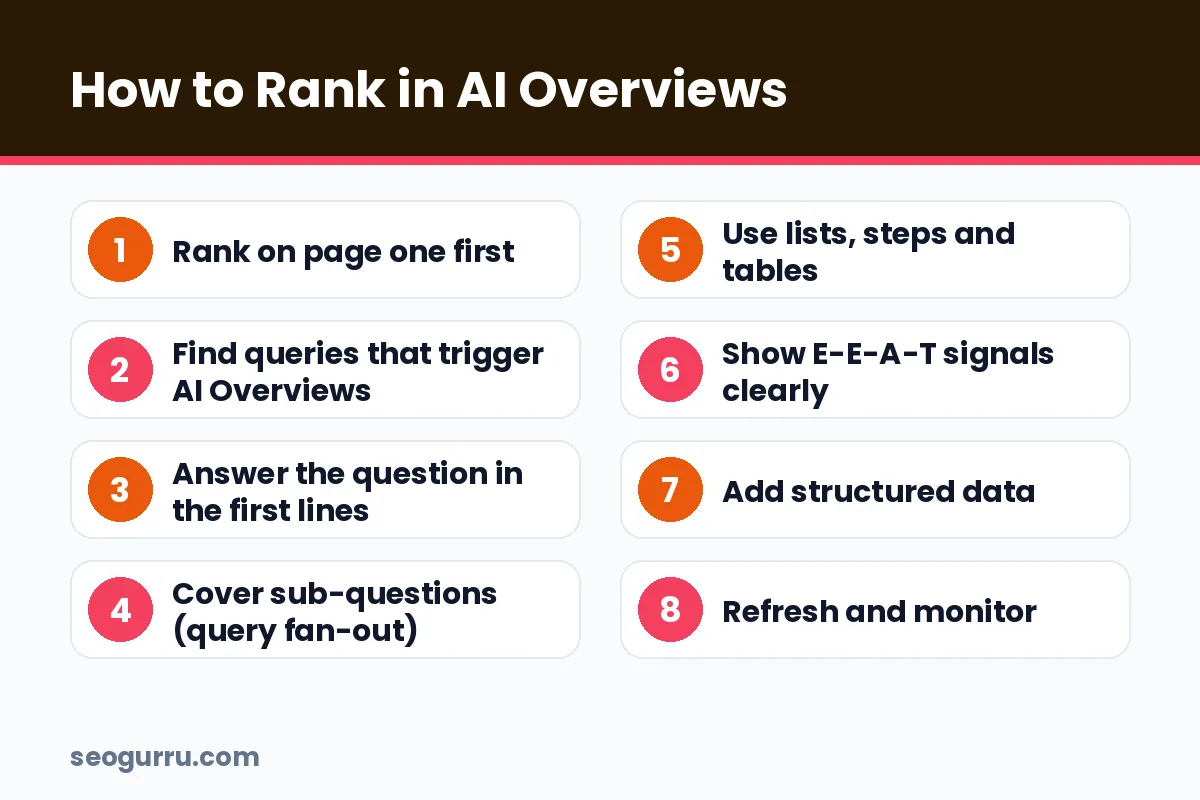
1. Rank on page one first
There’s no shortcut around this. Strong technical SEO, helpful content and quality backlinks remain the foundation. Start with our technical SEO checklist and on-page SEO checklist if you haven’t already.
2. Find queries that trigger AI Overviews
Use Ahrefs or Semrush to filter your keywords by SERP features that include AI Overviews. Prioritize queries where you already rank in the top ten, because those are your fastest wins.
3. Answer the question in the first lines
Under each heading, give a direct, self-contained answer in 40–60 words. Use the question’s own words. This makes your passage easy for Google to extract. Learn more in our answer engine optimization guide.
4. Cover sub-questions (query fan-out)
Because AI Mode and AI Overviews break questions into related searches, comprehensive pages that answer the follow-up questions have an advantage. For “how to start a podcast,” also cover equipment, costs, hosting, editing and promotion. Check People Also Ask boxes and related searches for ideas.
5. Use lists, steps and tables
Structured formats are easy to parse and summarize. Use numbered steps for processes, bullet lists for options and tables for comparisons.
6. Show E-E-A-T signals clearly
Google wants to cite trustworthy sources, especially for health, finance and legal topics. Strengthen:
- Experience: first-hand examples, photos and case studies
- Expertise: named authors with relevant credentials
- Authoritativeness: mentions and links from respected sites
- Trust: accurate facts, citations, clear contact details and policies
7. Add structured data
Schema markup won’t guarantee citations, but it helps Google understand your content and entities. Use Article, FAQPage, HowTo, Product and Organization schema where relevant. See our schema markup guide.
8. Refresh content and monitor results
Update statistics, examples and screenshots regularly. Track which keywords show AI Overviews, whether you’re cited, and how your click-through rate changes in Google Search Console.
- AI Overviews use Google’s core ranking systems, so SEO basics come first.
- Concise, self-contained answers are the most citable passages.
- Cover related sub-questions to benefit from query fan-out.
Content Types That Get Cited Most
- How-to guides with clear numbered steps
- Definitions with a one-paragraph explanation
- Comparisons with tables and verdicts
- Lists of options with pros and cons
- Expert explainers in health, finance, tech and home improvement
Can You Opt Out of AI Overviews?
You can limit how your content appears using snippet controls such as nosnippet, data-nosnippet or max-snippet. But these also affect your regular search snippets, which can hurt click-through rates. For most businesses, opting out does more harm than good. The better strategy is to earn citations.
How to Measure AI Overviews Performance
- Track AI Overview keywords in your rank tracker (Ahrefs, Semrush and others report this SERP feature).
- Check citations manually for your top 20 commercial and informational queries.
- Monitor CTR in Search Console. Google includes AI Overviews and AI Mode traffic in the overall Search performance report.
- Watch branded search. Exposure in AI answers often lifts brand searches over time.
- Measure conversions, not just clicks. Visitors from AI-heavy SERPs may be fewer but more qualified.
Industries Most Affected by AI Overviews
AI Overviews appear most often on informational queries. Industries with lots of “how,” “what” and “why” searches tend to see the biggest changes:
| Industry | Typical AI Overview queries | Best response |
|---|---|---|
| Health and wellness | Symptoms, treatments, diet tips | Expert-reviewed content with clear credentials |
| Finance | Definitions, calculations, comparisons | Data-rich explainers and calculators |
| Home improvement | How-to and cost questions | Step-by-step guides with photos and cost tables |
| Software and tech | Setup, troubleshooting, comparisons | Documentation, tutorials and comparison pages |
| Travel | Itineraries, best time to visit | First-hand guides with unique tips |
Transactional and local searches, such as “plumber near me” or “buy running shoes,” show AI Overviews less often. That’s another reason to balance informational content with strong service and product pages.
Common Mistakes
- Writing long intros before getting to the answer
- Covering only the main question and ignoring follow-ups
- Using AI-generated filler that adds nothing new
- Blocking Googlebot resources like CSS or JavaScript
- Ignoring freshness on fast-changing topics
Frequently Asked Questions
How do I get my website in Google AI Overviews?
Make sure your page is indexed and ranks well for the query, then add a clear, direct answer near the top of the relevant section. Cover related sub-questions, use structured formatting, show real expertise and keep the page updated. Google says normal SEO best practices apply.
Do AI Overviews reduce website traffic?
Studies show that AI Overviews often reduce click-through rates for organic results, especially on informational searches. However, pages cited within AI Overviews can still earn valuable, high-intent clicks and brand visibility.
Is there special markup for AI Overviews?
No. Google says there is no special schema or markup required to appear in AI Overviews. Standard structured data can help Google understand your content, but eligibility depends on being indexed and eligible for a snippet.
What is the difference between AI Overviews and AI Mode?
AI Overviews are summaries that appear at the top of regular search results for some queries. AI Mode is a separate conversational search experience that handles complex questions and follow-ups using query fan-out across many related searches.
Conclusion
AI Overviews have changed what “ranking” means. Being on page one is still the entry ticket, but being cited inside the overview is the new prize. Focus on clear, answer-first content, broad coverage of related questions, visible expertise and regular updates.
Start by finding ten keywords where you rank but aren’t cited, and rewrite those sections answer-first. Want help? Our AI SEO services are designed for AI search visibility, or get a free SEO analysis to see your opportunities.