Generative Engine Optimization (GEO): How to Get Cited by AI
AI tools now write answers instead of listing links. When someone asks ChatGPT for “the best CRM for small agencies,” it doesn’t show ten websites. It writes a summary and cites a handful of sources. Generative engine optimization (GEO) is how you become one of those sources.
This guide explains what GEO is, how generative engines choose content, and the practical tactics that make your brand more likely to be mentioned and cited. You’ll also see how GEO fits with SEO and AEO, so you don’t have to rebuild your strategy from scratch.
Generative engine optimization (GEO) is the practice of optimizing content and brand signals so that AI systems like ChatGPT, Gemini, Perplexity and Google AI Overviews mention and cite you in their generated answers. It builds on SEO, adding a focus on citable facts, clear structure, and brand authority across the web.
What Is Generative Engine Optimization (GEO)?
Generative engine optimization (GEO) is the process of improving your content’s visibility inside responses created by generative AI search engines. The goal is to be mentioned, quoted or linked when an AI model answers a question related to your business.
The term was popularized by a 2023 research paper from Princeton University and partners, titled “GEO: Generative Engine Optimization”. The researchers tested content changes and found that some methods, like adding statistics, quotations and citations, increased source visibility in generative answers by up to about 40%.
What does GEO mean in SEO?
In SEO conversations, “GEO” now usually means optimizing for AI-generated search, not geographic targeting. If you see “GEO SEO,” check the context. Local and geographic SEO is a different discipline.
How Generative Engines Choose Sources
Most AI search tools follow a similar process, often called retrieval-augmented generation (RAG):
- Understand the query and break it into sub-questions
- Retrieve documents from a search index (Google, Bing or their own crawler)
- Select passages that are relevant, clear and trustworthy
- Generate an answer that synthesizes those passages
- Cite sources that contributed key facts
This means two things matter: you must be retrievable (indexed and ranking reasonably well), and your passages must be worth quoting (specific, factual and easy to extract).
GEO vs SEO vs AEO
| SEO | AEO | GEO | |
|---|---|---|---|
| Target | Search rankings | Direct answers, snippets, voice | AI-generated responses |
| Output | Blue links | One answer | Synthesized summary with citations |
| Key tactic | Relevance + authority | Answer-first formatting | Citable facts + brand mentions |
| Main metric | Rankings, clicks | Snippet ownership | Citations, share of voice in AI |
The three overlap heavily. Strong SEO gets you retrieved, answer engine optimization makes you extractable, and GEO makes you the source the AI prefers to trust and mention.
Generative engines don’t rank pages. They assemble answers from the most quotable evidence they can find.
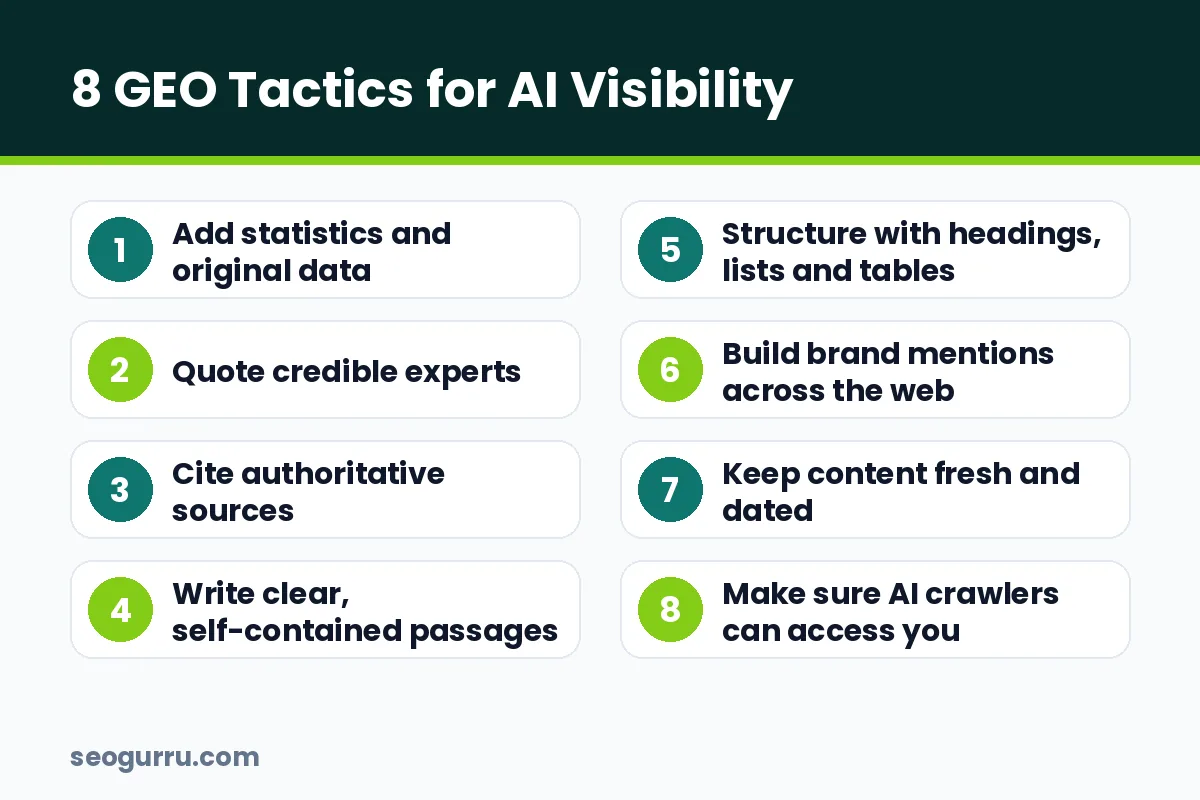
8 GEO Tactics That Increase AI Citations
1. Add statistics and original data
AI models love concrete numbers. Replace vague claims (“many businesses struggle”) with specific data (“in our survey of 214 agencies, 62% said…”). Original research is especially powerful because the AI can only cite you for it.
2. Quote credible experts
Include short quotes from named experts with their credentials. Quotes add authority and are easy for generative engines to lift. If your team has specialists, quote them by name and title.
3. Cite authoritative sources
Link to primary sources such as government data, academic studies and official documentation. This signals accuracy and helps AI systems verify your claims against other trusted sources.
4. Write clear, self-contained passages
Each paragraph should make sense on its own. Avoid “as mentioned above” or “this” without context. A passage that clearly states the subject, the fact and the context is much easier to cite.
Example:
- Hard to cite: “It usually takes a while, depending on things.”
- Easy to cite: “Most websites start seeing SEO results within four to six months, depending on competition, site authority and content quality.”
5. Structure with headings, lists and tables
Use descriptive H2 and H3 headings, numbered steps and comparison tables. Structure helps AI retrieval systems find the right chunk of your page for each sub-question.
6. Build brand mentions across the web
Generative engines learn which brands are associated with which topics. Mentions in industry publications, podcasts, review sites, Reddit discussions and “best of” lists all strengthen that association, even without a link. Digital PR is now a core GEO channel.
7. Keep content fresh and dated
Many AI search tools favor recent information for time-sensitive questions. Show a clear “last updated” date, refresh statistics regularly and remove outdated advice.
8. Make sure AI crawlers can access you
Check your robots.txt, CDN and firewall settings. If you block crawlers like OAI-SearchBot (ChatGPT search), PerplexityBot or Bingbot, those tools may not be able to retrieve your pages. Decide deliberately which bots to allow. OpenAI documents its crawlers on its bots overview page.
- GEO builds on SEO: if you’re not indexed and trusted, you won’t be cited.
- Specific facts, quotes and sources make content more quotable.
- Brand mentions across the web shape what AI “knows” about you.
A Simple GEO Workflow for Existing Content
You don’t need to start from scratch. Most of the fastest GEO wins come from upgrading pages you already have. Use this workflow on your ten most important pages:
- Pick the target questions. List the three to five questions each page should answer for AI users.
- Test the current answers. Ask those questions in ChatGPT, Perplexity and Google. Note which sources get cited and what facts they use.
- Find the gaps. Compare your page with the cited sources. Are you missing a statistic, a definition, a comparison table or a clear step-by-step process?
- Upgrade the page. Add an answer-first summary, specific data points, expert quotes and links to primary sources.
- Strengthen the entity. Make sure your author bio, Organization schema and About page clearly describe who you are and why you’re credible.
- Re-test in 4–6 weeks. Check the same prompts again and record any new mentions or citations.
GEO example: before and after
Before: “Email marketing is still very effective for lots of businesses and can bring a good return.”
After: “Email marketing remains one of the highest-ROI channels. According to Litmus research, brands often report returns of around $36 for every $1 spent. Results depend on list quality, segmentation and how often you test subject lines.”
The second version gives an AI engine a specific, attributed fact it can quote with confidence. It’s also more useful to human readers.
How to Measure GEO Performance
GEO measurement is still maturing, but you can track it today:
- Prompt tracking: keep a list of 20–50 priority questions and check monthly which brands ChatGPT, Perplexity, Gemini and Google AI Overviews cite
- AI referral traffic: in GA4, filter sessions from chatgpt.com, perplexity.ai, gemini.google.com and copilot.microsoft.com
- Branded search trends: rising branded queries in Google Search Console often follow AI exposure
- Share of voice tools: platforms like Ahrefs Brand Radar and other AI visibility trackers estimate mention share across AI answers
Common GEO Myths
- “GEO replaces SEO.” False. Most generative engines retrieve from search indexes, so rankings still matter.
- “You need special AI-only content.” Mostly false. Clear, expert, well-structured content works for both humans and machines.
- “Keyword stuffing helps AI find you.” False. The Princeton study found keyword stuffing performed poorly compared with adding facts and sources.
Frequently Asked Questions
What is generative engine optimization in simple terms?
Generative engine optimization is the practice of making your content easy for AI tools like ChatGPT and Google AI Overviews to find, trust and quote. It focuses on clear facts, credible sources, good structure and strong brand presence so AI answers mention your business.
Is GEO different from SEO?
GEO is an extension of SEO rather than a replacement. SEO helps your pages rank and get retrieved, while GEO improves the chance that retrieved content is quoted in AI-generated answers. Most successful GEO strategies are built on solid SEO foundations.
How long does it take to see GEO results?
Updates to existing pages that already rank can be picked up by AI search tools within weeks. Building broader brand authority for consistent AI mentions usually takes several months of content, PR and link-building work.
Which AI platforms should I optimize for?
Prioritize Google AI Overviews and AI Mode because of Google’s reach, then ChatGPT search, Perplexity, Microsoft Copilot and Gemini. Most of the same tactics apply to all of them.
Conclusion
Generative engine optimization is about becoming the source AI trusts. Make sure you’re crawlable and ranking, then make your content easy to quote with specific data, expert insights and authoritative citations. Build your brand’s presence across the web so AI models connect your name with your topic.
Start by auditing your top ten pages for quotable facts and clear structure. If you’d like help, our AI SEO services are built to increase your visibility in AI search, or you can get a free SEO analysis to find your quickest wins.